
AI media buying case: 15 bots built, five survived
One agency built about 15 AI agents for its media buyers and kept five. Its autonomous buyer bot spent roughly $1,000 of a $5,000 test and shut everything down.
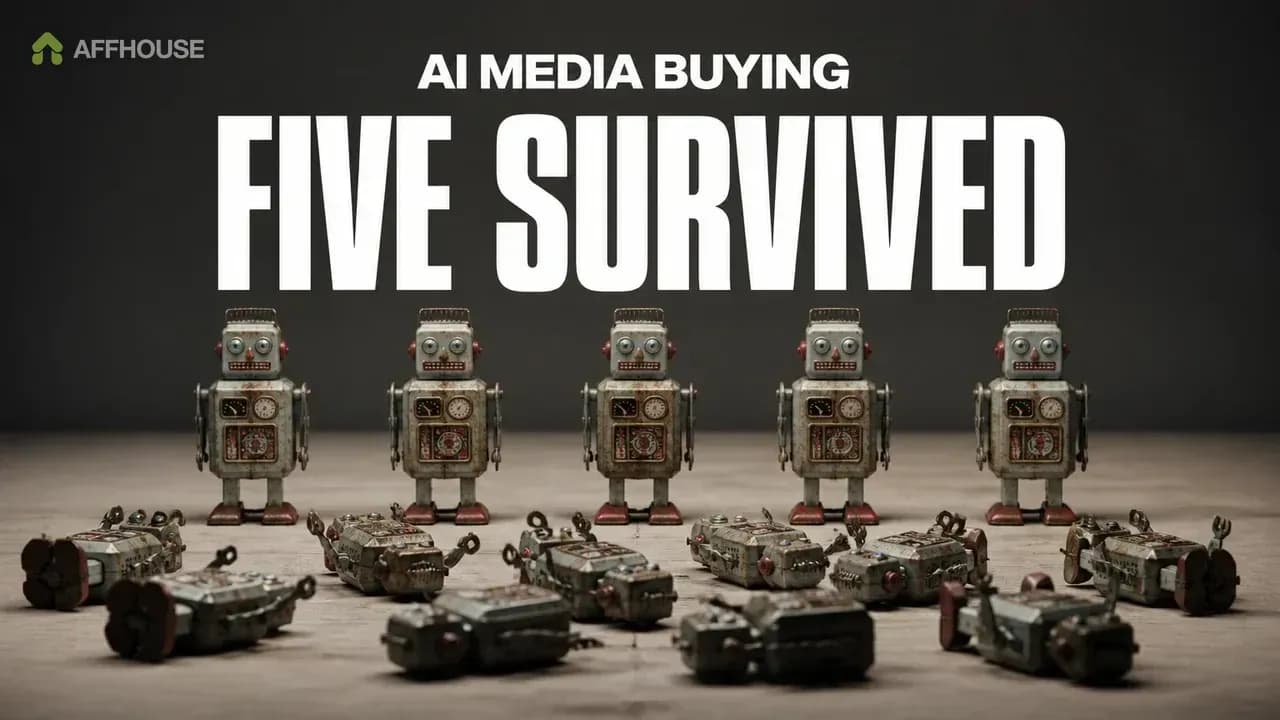
In an AI media buying test, Wildo Agency built about 15 bots and kept five. Its autonomous buyer bot spent about $1,000 of a $5,000 budget, judged every creative a loser and switched them all off. Peak AI spend reached about $3,500 a month. The agency's CEO reported all figures; none were independently verified.
Results at a glance
| Metric | Value | Note |
|---|---|---|
| Bots built vs kept | About 15 built, 5 kept | Reported by the agency's CEO, not independently verified |
| Test budget | $5,000 per arm, two arms, same tested creatives | Reported by the agency's CEO, not independently verified |
| Autonomous bot arm | About $1,000 spent, then all creatives off | ROI just under 61% on too little data (ROI definition not given); the CEO called it meaningless |
| Peak AI spend | About $3,500 a month, falling since | Reported by the agency's CEO, not independently verified |
| PWA design output | About $30,000 a month at market rates, about $600 actual cost | Market-price equivalent, not cash saved; agency-reported |
| Period | Automation from October 2025, full build from November 2025 | Results presented at an industry conference in 2026 |
Context: AI in media buying, one agency's version
Vendors pitch autonomous ad managers, yet a media buyer still has to sort the work task by task: what a model can be trusted with, and what it will waste money on. For most teams, AI media buying is that sorting exercise.
Wildo Agency is a media-buying team. Bogdan Right, introduced as its CEO, presented the agency's results at an industry conference in 2026. AffHouse found no agency website, LinkedIn page or company record that confirms the agency or his role, so everything below is his account.
His summary was blunt: treat the model as a pair of hands, not as the person deciding.
What they did
The agency built its system in layers. At the top, an orchestrator on Anthropic's Claude Opus handed work to specialist agents. The team picked a model per job: OpenAI's ChatGPT for copy, Google's Nano Banana image model for visuals, and the workflow automation tool n8n to connect them. Inside a single bot, Opus handled reasoning and the cheaper Claude Sonnet handled repetitive collection to keep token bills down.
Five agents survived testing:
App builder. Built Android apps and progressive web app (PWA) designs from start to finish.
Facebook/Meta account bot. Ran account acquisition and set-up, a grey-area workflow the source describes and this article neither explains nor endorses, and configured auto-rules on those accounts.
Affiliate-chat bot ("Alf"). Kept a searchable record of what partner programs agreed in chat, from KPIs and budgets to caps and live offers, and reconciled it against the tracker.
In-app campaign bot. Launched campaigns, produced daily analytics and reports, and uploaded creatives from the library on a buyer's command.
Team-lead bot. Gave team leads a performance signal: it read Notion records of each buyer's output, such as campaigns launched and design briefs handed over, and raised a flag when someone slipped.
Before building anything, the agency now asks five questions. The framework is the CEO's; the examples are ours.
Money. Does the bot earn or save a figure you can name? A reconciliation that catches a cap overrun qualifies.
Time and frequency. Is the task long, or short but constant? Either can justify a bot.
Cost of delay. Does waiting for a person lose money, as an overspend that runs overnight does?
Process stability. Is the task done the same way every time? Work that changes from case to case tends to break automation.
Cost and reversibility of errors. What does a wrong action cost, and can it be rolled back? Expensive or permanent mistakes stay with people.
Results
Both test arms started from identical conditions: $5,000 each, a shared batch of creatives that had already passed testing, and one stop rule, which was to pause a campaign once the cost per install or target action got too high. What differed was who acted. In the assisted arm the bot recommended and the buyer decided; in the autonomous arm the bot launched, paused and managed campaigns itself.
On paper the bot had the edge: its rules ran on live Facebook/Meta spend and tracker or network revenue, while a person reads dashboards with a delay. Yet the autonomous arm stalled at about $1,000. The buyer-assisted arm spent the full $5,000. Its ROI was lower than the bot arm's thin-data figure, and the agency gave no number. The CEO's point was that a creative batch only pays back if it is run through. A buyer who sees one bad day after a good one tends to give the campaign another day, and that patience was missing from the bot.
The agency dropped the idea of a fully autonomous AI buyer for now; the CEO described the bot as a helper for the buyer, not a replacement. One exception remains. At night, the bot may pause a campaign that has turned unprofitable, because delay costs money in that case. The agency did not explain how this fits its rule, covered below, that bots make no decisions. Anyone copying the setup should decide where that line sits before going live.
The measurable gains came from the support bots. Per the CEO, the app builder let the agency shrink its development department to a single developer. He put the market value of the custom PWA designs it produced at about $30,000 a month, against roughly $600 of actual cost; that is a market-price equivalent, not cash saved. Alf left one person in the affiliate department, and team-lead reporting now runs on its own.
Monthly AI spend peaked at about $3,500 and, per the CEO, keeps falling. He said most of the automated work is API calls, spreadsheets and calculations, which models handle cheaply. Once the team knew the routine, turning a simple repeatable task into a standalone script cost about $20 in tokens.
He would not give a time-saved figure per buyer. Some buyers worked more with the freed time and others worked less, so he declined to claim a percentage.
What did not work
The autonomous buyer. Within about $1,000 of spend, the bot had written off the whole creative set and paused it ad by ad. Its ROI of just under 61% rested on too little spend to mean anything, as the CEO said himself. A batch of 10 to 20 designer-made creatives costs real money, and in his view a bot on its own will not earn that back.
Video at volume. The agency was satisfied with AI still images when the model got good references. Video was harder. Per the CEO, AI could not reliably produce clips longer than about five seconds that viewers trust as much as designer-made ones, at the volume the agency runs. One strong clip was possible, but each new concept needed fresh references, so at scale it was neither faster nor cheaper. For another team's numbers on AI video ads, see this AI UGC case.
A bot that made a decision. The policy came from a tracker incident: a bot working on a task duplicated 70 campaigns, then moved to delete 100 and took out 30 working campaigns along the way. The rule since then, per the CEO: bots make no decisions at all, now or possibly for years.
Automating too much. The CEO said he once automated a process that took about 30 minutes a week and cost about $100, and the automation work took longer than the process ever would.
One developer as a single point of failure. Asked what happens if that developer leaves, the CEO's answer was to pay them well. In our view, that is a retention policy, not a backup plan.
Takeaways for affiliates
Use AI for media buying as hands, not judgment. Let it collect, reconcile and report; keep budget and creative calls with the buyer.
Allow autonomous actions only when they are urgent, pre-defined and reversible, such as a night-time pause. Meta's own ad rules can check ads on a schedule and pause them, so try those before building a custom agent.
Test any agent in a capped arm with a written stop-loss before it touches real scale, and compare it with a buyer-run arm on the same creatives.
Run each candidate task through the five questions above, especially the cost and reversibility of a mistake.
Route reasoning to a stronger model and bulk collection to a cheaper one, and track token spend monthly.
Before connecting an agent to your ad account, read what the Meta Ads MCP can and cannot do.
FAQ
Can AI replace a media buyer?
Not in this case. The autonomous bot spent about $1,000 of its $5,000 budget and switched everything off before it had enough data. The CEO concluded the bot is a helper, not a replacement, and gave it one autonomous job: pausing unprofitable campaigns overnight.
What tasks are safe to give an AI agent in media buying?
Repetitive, reversible and time-sensitive ones: reports, data collection from partner chats, tracker reconciliation and night-time pauses. The agency also asks whether each task saves money, how often it runs, whether the process is stable, and what an error would cost.
How much does it cost to run AI agents for a media-buying team?
The agency reported a peak of about $3,500 a month on AI, falling over time, and about $20 in tokens to turn one simple task into a script. These are its own figures and were not independently verified.
Can AI make ad creatives as well as a designer?
For images, it produced acceptable results when given good references. For video longer than a few seconds, the agency said AI could not match designer-made clips at volume, so people still produce those.
Sources
Google AI for Developers, Gemini API image generation (Nano Banana)
Anthropic, Claude models overview
n8n, n8n documentation
Meta for Developers, Ad Rules Engine
Meta for Developers, Ad rules execution spec
Case figures were reported by Wildo Agency's CEO at an industry conference in 2026 and were not independently verified by AffHouse.