
Player lifetime value case: $9,125 in CPA, $61,376 GGR
365 first depositors from a 2024 India crash-game campaign cost the operator $9,125 in CPA. By May 2025 they had produced $61,376 in GGR. The buyer's payout topped its spend by about $1,200.
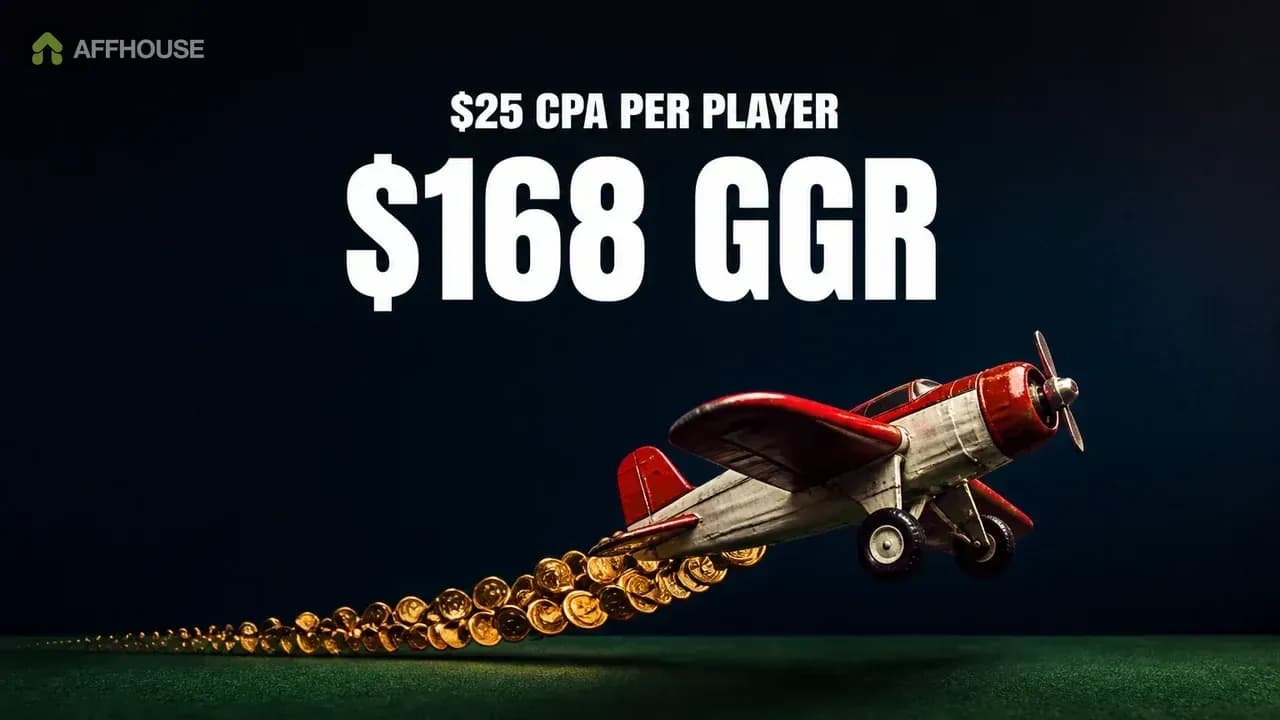
Player lifetime value is what a depositor is worth over months of play, not at the first deposit. In a 2024 India crash-game campaign, 365 first depositors cost the operator 4RABET $9,125 in CPA. By May 2025, by the operator's figures, they had produced $61,376 in gross gaming revenue. The buyer's reported payout topped its ad spend by about $1,208.
Results at a glance
Figures come from the agency and the operator. None were independently verified; the ratios are our arithmetic.
| Metric | Value | Note |
|---|---|---|
| Period, GEO, source | Feb-Apr 2024, India, Facebook | Reported by the agency, Ace of Ads |
| Buyer's ad spend | $7,917 | Reported by the agency, not independently verified; the case does not say what it includes |
| Operator's CPA payout | $9,125 (365 FTDs x $25) | Reported; the arithmetic checks |
| Buyer's payout minus spend | $1,208, about 15% on spend | Our arithmetic from reported figures; the case states "ROI 30%", which does not reconcile with them |
| Repeat deposits | 2,072, about 5.7 per FTD | Reported by the operator, not independently verified |
| Operator's GGR from the cohort | $61,376, about 6.7x the CPA cost | Reported by the operator as of the case's writing; gross, before bonuses and other costs |
Context
The case puts two answers to "did it pay off?" side by side. The buyer was paid once, at the first deposit. The operator kept all the revenue from play after that. The gap between those two positions is the practical meaning of player lifetime value.
The campaign promoted crash games: Aviator, Aviatrix, Jetix and Spaceman, multiplier games where the player cashes out before a rising line "crashes". Crash-game traffic has a reputation for failing to pay back advertisers. The agency published the case to argue the opposite.
The deal was a flat CPA of $25 per first-time depositor (FTD), so the affiliate's income was fixed at approval. That also sets each side's payback period, meaning how long a player's revenue takes to cover the cost of acquiring them: the buyer's came at approval, while the operator had to wait for repeat play.
The legal setting has changed since. According to a government backgrounder, India's Promotion and Regulation of Online Gaming Act, 2025, enacted in August 2025, bans online money games and their advertising, with its rules taking effect on 1 May 2026. The campaign ran in early 2024, before the Act. This is a summary of a government document, not legal advice.
The case appeared in May 2025 as sponsored material in Russian-language affiliate trade media, written by Ace of Ads with figures supplied by 4RABET. Treat every number in it as a claim.
What they did
The agency described its setup as aimed at player quality rather than lead price. Three choices stand out.
Creatives that showed the game
The ads showed crash gameplay and little else. According to the agency's chief business development officer, creatives like this do not produce the cheapest leads, but they attract people drawn in by the game itself, who may stay longer. The case gives no cost per lead and no comparison with other creatives, so this is the agency's reasoning, not a tested result.
Audience settings
Delivery was restricted to Android 10 or newer devices with the browser language set to English. Within that, the ads reached only men aged 30 and over, and eight Indian states were left out. The case gives no test of them against a broader audience, so their effect on retention is the agency's claim, not a measured result.
Infrastructure
The landing pages were progressive web apps on domains the agency bought and hosted on its own servers. The agency's stated reason was knowing the domains stayed reachable, rather than relying on a provider's.
Results: what player lifetime value looked like
Player lifetime value in this case is about $168 of GGR per player so far ($61,376 / 365), set against the $25 the operator paid to acquire each one.
Each player then made, on average, 5.7 repeat deposits worth $272 in total, about $48 per deposit. Gross gaming revenue came to roughly $168 per player, or $61,376 across the cohort. That is about 6.7 times what the operator paid for the players.
The program's partner dashboard shows only 180 days of data, so the operator exported the GGR figure separately. The case gives the figures as of its writing and does not date the export. It was published in May 2025, 13 to 15 months after the campaign.
The two returns look like this:
Buyer: reported spend of $7,917 and a payout of $9,125, a difference of $1,208. That is about 15% on reported spend for three months of work, paid once at the first deposit.
Operator: spent $9,125 on CPA and recorded $61,376 in GGR. The case computes a 573% "ROI" from these two numbers.
The figures are not comparable. The buyer's roughly 15% is a margin on reported ad spend. The case does not say whether the spend figure includes creatives, hosting or team time, so it may overstate what the agency actually kept. The operator's 573% is a gross figure. It ignores bonuses, payment fees, game-provider fees, platform costs and any taxes, all of which come out of GGR before it becomes profit.
How the numbers are counted
The case uses the simplest cohort method, which is common in affiliate metrics:
LTV (per player) = cumulative GGR of the cohort / number of FTDs = $61,376 / 365 = about $168.
LTV to CAC ratio = LTV / acquisition cost per player = $168 / $25 = about 6.7.
ROI = (GGR - acquisition cost) / acquisition cost = ($61,376 - $9,125) / $9,125 = about 573%.
Deposits are not revenue. Cumulative deposits can include winnings a player puts back in, so the $99,400 is not a net inflow and should not be read as a measure of value on its own.
What did not work
Not all crash games are equal. The operator prices traffic by player quality, not by conversion rate. By its account, Aviator players lead on retention and first-deposit quality, so it pays more for them and still welcomes that traffic. Plinko converts better, but those players bring so little afterwards that the operator pays a much lower CPA for them, and Plinko traffic has largely dropped off its accepted list.
The stated ROI does not reconcile. The case says 30%; its own spend and payout give about 15%, and it does not explain the difference.
GGR is not profit, and the export date is missing, so the exact age of the $61,376 figure is unknown.
One campaign, one operator, one GEO, published by the two companies that benefit from it. Cases get written up because they worked; failed tests rarely are.
The setup carries platform risk. The traffic ran from Facebook to PWA landers for a casino brand. As of October 2026, Meta's gambling ad standards allow online gambling ads only from ad accounts that have obtained authorization, and the rule also covers affiliate pages. That page describes today's rules, not those of 2024, and the case does not say whether the campaign's ad accounts were authorized.
Takeaways for affiliates
The transferable lesson is about deal structure, not about India.
Ask who keeps the lifetime value. On a flat CPA, the operator does. If your players retain well, a RevShare or hybrid deal lets you share in it; compare the options in CPA vs RevShare vs Hybrid.
Price CPA with LTV and payback in mind. Here, the operator paid $25 for players worth about $168 in GGR, so its payback period on each player was short. Cohort data like this is your evidence when you ask for a higher rate.
Judge creatives by the players they bring, not only by lead price. The agency's view is that gameplay-only ads lose on lead price but win on player quality. The case does not prove it, so check it on your own cohorts, the same logic as paying for players who actually play.
Compare offers by retention, not just approval rate or conversion rate. The Plinko vs Aviator contrast shows a high-converting offer can be the one an operator later stops accepting.
Track past the dashboard window. If a program's partner dashboard stops at 180 days, ask for cohort exports and keep your own postback data.
Recompute every ROI a case gives you. This one stated 30%; its own spend and payout give about 15%.
FAQ
What does LTV mean, and how is player lifetime value calculated?
LTV, or lifetime value, is the revenue a player brings over the whole time they keep playing. The textbook formula is average revenue per player per period multiplied by the number of periods a player stays active, for example monthly revenue times months active. A simpler cohort version, used in this case, divides the total GGR a group of players produced by the number of players: $61,376 / 365 = about $168.
What is a good LTV to CAC ratio?
A 3:1 LTV to CAC ratio is a widely quoted rule of thumb from SaaS, not an iGaming benchmark. This case showed about 6.7:1, but that is gross GGR before bonuses and costs, from one cohort, so it is not a target to plan around.
Why do operators pay CPA if lifetime value is higher?
Operators often prefer CPA because it buys players at a known, fixed cost and leaves the long tail of revenue with them. RevShare moves part of that upside, and the risk of players who leave early, to the affiliate.
How is LTV different from ROI?
LTV measures how much revenue or margin a player brings over time. ROI compares a return with the cost that produced it. In this case, by our arithmetic from reported figures, the same cohort gave the buyer about a 15% return on reported spend and the operator a 573% gross ROI.
Sources
Press Information Bureau, Government of India, A New Era of Online Gaming Governance (backgrounder, 30 April 2026)
Meta Transparency Center, Online Gambling and Games: Advertising Standards