
What is a social casino? Sweepstakes vs social casinos
Social casinos sell coins with no cash value. Sweepstakes casinos add a second coin you can redeem for prizes. How each works, why states ban sweeps and what affiliates risk.
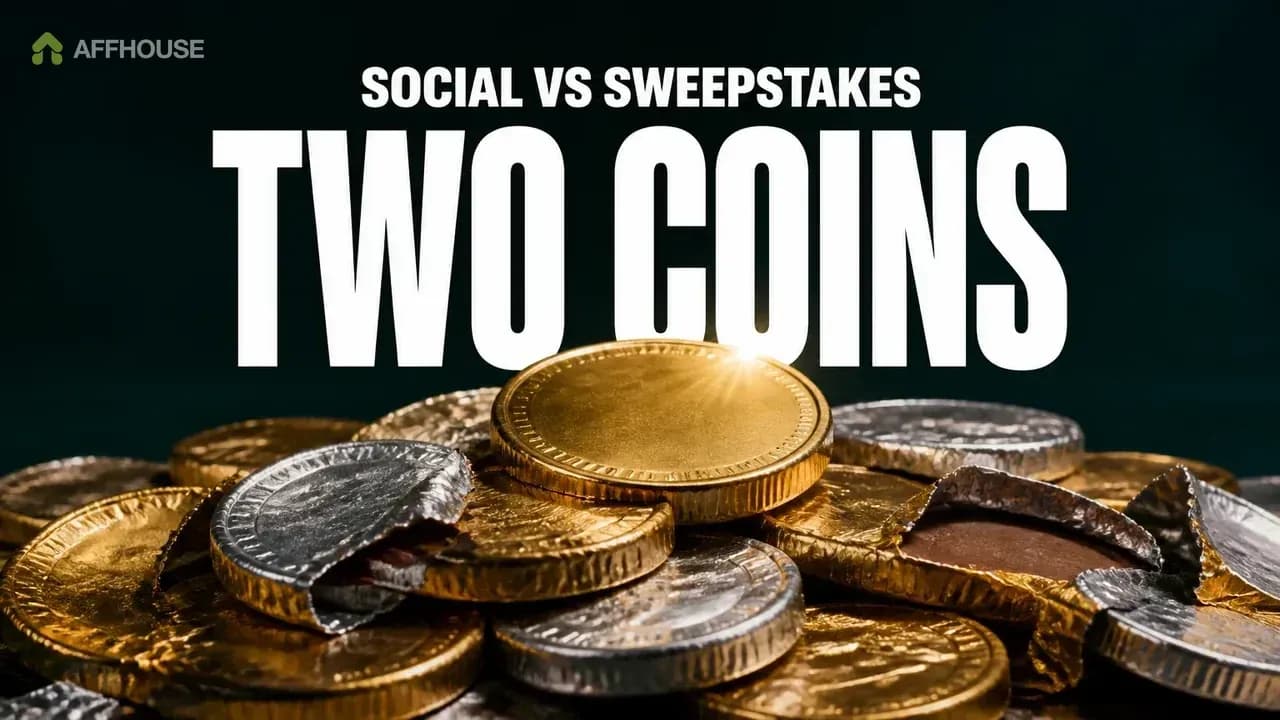
A social casino is a free-to-play casino-style game that sells virtual coins and never pays out cash. A sweepstakes casino looks the same but adds a second coin, usually called Sweeps Coins, that players can redeem for cash prizes. That second coin is why sweepstakes casinos are now banned or restricted in a growing list of US states.
Below: coin mechanics, state rules as of October 2026 and the affiliate side. For industry context, see what iGaming is.
What is a social casino?
A social casino is an app or browser game that copies slots, poker, roulette and other casino formats but runs on coins with no cash value. Meta's ad rules define these as games that simulate casino gambling with no opportunity to win money or money's worth. Players can win more coins but never withdraw them.
Commercially it is a free-to-play game: a free download with a starter balance. When coins run out or a player wants a longer session, the app sells coin packs. Timed free top-ups, missions and leaderboards bring players back, and many apps also earn from in-game ads.
Because nothing of cash value leaves the game, social casinos are generally treated as entertainment rather than licensed gambling, with one court exception covered below.
What is a sweepstakes casino?
A sweepstakes casino, or sweeps casino, is a social casino with a second, redeemable currency. The games look the same, but the platform also runs a promotional sweepstakes: some coins can be played for prizes and, after identity checks, exchanged for cash or gift cards.
Operators frame it as two products in one account: a social game where you can buy coins, and a free-to-enter sweepstakes that buying cannot improve. The rules we checked open with it: no purchase is necessary, and buying does not raise the chance of winning.
Cash prizes are why some sites say "real money social casino". The phrase misleads: players never stake cash on a spin, and prizes come from redeeming promotional coins.
How do sweepstakes casinos work?
Sweepstakes casinos run on two coins: Gold Coins that players buy for play, and Sweeps Coins, given free or with purchases, that can be redeemed for prizes after play-through and verification. We read the published sweepstakes rules of Chumba Casino, run by VGW (version dated September 16, 2026). Names, rates and limits differ between operators, but the structure is shared:
Gold Coins (GC): the play currency, sold in packs. They cannot be redeemed for prizes, and purchases are final.
Sweeps Coins (SC): promotional entries. SC games can win more SC, and SC won through play can be redeemed.
The player journey under those rules:
Qualify. Prize play is for adults 21 or older, and residents of 16 excluded states cannot take part.
Collect SC. Four routes: free SC with marked Gold Coin packs, no-cost social media giveaways, a daily bonus and a free online entry request. The free routes are the alternative method of entry (AMOE) behind the "no purchase necessary" claim.
Play through. SC must be played at least once before redemption; the operator can require up to 20 times.
Pass verification. A win on screen is not a prize until eligibility and the winning play are checked.
Redeem. Each SC won through play is worth a $1 prize, with a 100 SC ($100) minimum. Cash prizes are paid to the account or wallet used to buy Gold Coins, with a nominated bank account as fallback; gift cards are the other option.
Worked example: a verified player holding 130 eligible SC with play-through cleared can request a $130 prize. Below 100 SC there is nothing to redeem, and coins idle for 60 days after the last login expire.
Social vs sweepstakes vs real-money casino
The three products look alike on screen; they differ in whether cash can come out and which law, if any, licenses them.
| Social casino | Sweepstakes casino | Real-money online casino | |
|---|---|---|---|
| What the player pays for | Virtual coin packs | Gold Coin packs plus bonus SC | Deposits staked directly on games |
| Cash out | No | SC won through play, after verification | Yes |
| Legal basis | Entertainment game with no prize of value | Promotional sweepstakes law, now contested | State gaming license |
| Who polices it | App stores, ad platforms, consumer law | State lawmakers, prosecutors, gaming regulators | State gaming regulator |
| Minimum age | Set by app and platform (Meta ads: 18+) | Set by operator (21+ at the one we checked) | Set by state law |
| Availability | Broad | Shrinking, state by state | Only states that license online casinos |
| Typical affiliate deal | Varies by publisher | CPA on sign-up or first purchase, RevShare | CPA, RevShare, hybrid, with state approval |
How do sweepstakes and social casinos make money?
Social casinos sell coins and, often, ad inventory. No cash prize leaves the system, so there is no payout risk. As in most free-to-play games, a minority of heavy buyers often drives revenue.
Sweepstakes casinos sell Gold Coin packs; the bundled SC are a promotional cost, and redeemed prizes are the main payout. The operator keeps coin sales minus redeemed prizes, payment processing, chargebacks, identity checks and legal costs.
Game math, play-through, the redemption minimum, coin expiry and verification decide how much of an SC balance becomes a paid prize.
Are sweepstakes casinos legal?
Whether sweepstakes casinos are legal depends on the state: operators say free entry keeps them outside gambling law, while at least five states now ban dual-currency games by statute.
Most US gambling laws turn on three elements: a prize, chance and consideration, meaning something of value paid to play. Remove one and you generally have a lawful promotion, which is how a soft-drink brand runs a free prize draw. Sweepstakes casinos rely on that: SC are always available free, so nobody pays for a chance at a prize, and Gold Coins are sold as entertainment.
States that have legislated reject the split. California counts coins given free as a bonus or "with the purchase of a related product", play coins included, as indirect consideration. Bundling free SC with a paid pack no longer removes consideration.
As of October 2026, state laws aimed at dual-currency online sweepstakes games include:
New Jersey: A5447 (P.L. 2025, c. 128), signed August 15, 2025, effective immediately.
California: AB 831 (Chapter 623 of 2025), signed October 11, 2025, in force since January 1, 2026. Offering an online sweepstakes game is a misdemeanor.
New York: S5935A (Chapter 605 of 2025), signed December 5, 2025, effective immediately. The State Gaming Commission defines what counts as a dual-currency system.
Maine: LD 2007 (Public Law ch. 645), signed April 6, 2026, in force since July 29, 2026.
Louisiana: HB 883 (2026 Regular Session), effective August 1, 2026, treating these games as gambling by computer.
The list is not complete: other states have laws or regulator actions not reviewed here, and bills move every session. The operator rules we read, a practical cross-check, exclude 16 states: California, Connecticut, Delaware, Idaho, Indiana, Louisiana, Maine, Michigan, Mississippi, Montana, Nevada, New Jersey, New York, Tennessee, Washington and West Virginia. That is one company's risk call, not a legal map.
Social casinos carry less exposure but are not immune. In Kater v. Churchill Downs (2018), the Ninth Circuit held that virtual chips that extend play are a "thing of value" under Washington law, making that app illegal gambling there. California's new law, by contrast, does not reach games that award no cash or cash equivalents.
The fight resembles state challenges to sports contracts on prediction markets. For licensed casino and sports betting by state, see is online gambling legal in the US.
This summarises public statutes, court records and operator documents as of October 2026. It is not legal advice.
How affiliates earn and what to watch
Sweepstakes casino programs use the usual casino models, priced on coin purchases instead of deposits: CPA on a registration or first Gold Coin purchase, RevShare on net revenue (typically coin sales minus redeemed prizes and other deductions), or a hybrid. Get the RevShare formula in writing; it is not a licensed casino's NGR. See CPA vs RevShare vs Hybrid for how to compare offers.
The risks to price in:
Laws now name affiliates. California makes it a crime for a "media affiliate" to knowingly and willfully support the promotion of an online sweepstakes game in the state: a $1,000 to $25,000 fine, up to a year in county jail, or both. New York's law also lists media affiliates, with fines of $10,000 to $100,000 per violation and possible loss of, or ineligibility for, a state gaming license.
Program terms exclude states. That traffic cannot enter prize play, does not convert and may breach your agreement. When a brand leaves a state, revenue from your players there stops.
Ad platforms treat sweeps as gambling. Meta requires its authorization for sweepstakes ads, including affiliate landing pages, and allows social casino ads only to people 18 or older with nothing of monetary value on offer. Reddit takes sweepstakes, casino-themed apps and social gaming only from pre-approved advertisers working with its sales team.
Disclosure. Federal endorsement rules require clear disclosure of paid relationships, affiliate commissions included.
A compliant promotion excludes restricted states in targeting and copy, states eligibility and the operator's age rule (21+ at the one we checked), shows the free entry route, avoids "real money casino" and guaranteed-win language, and keeps a dated record of each program's excluded states. Add responsible-play messaging: these products are for adults, and coin purchases are entertainment spend.
One naming trap: in affiliate networks, "sweepstakes offers" usually means lead-generation prize draws paid per sign-up (SOI or DOI), a separate vertical.
FAQ
Are sweepstakes considered gambling?
Whether sweepstakes casinos count as gambling depends on the state. Operators argue that free entry removes consideration, making their games lawful promotions. California, New York, New Jersey, Maine and Louisiana now prohibit dual-currency online sweepstakes games by statute, and operators exclude more states on their own.
What is SC money, and how do you cash out?
SC means Sweeps Coins: promotional coins played for more SC and, once won through play, redeemable for prizes. At the operator we checked, one eligible SC equals a $1 prize, redemption starts at 100 SC, and identity verification comes first.
How long does a sweepstakes casino take to pay out?
Sweepstakes casino payouts have no standard timeline: they depend on the operator, the payment method and how fast identity checks clear. The rules we reviewed set none.
Are social casinos legal?
Social casinos generally sit outside gambling licensing because no prize of cash value leaves the game, but it depends on the state. A 2018 Ninth Circuit ruling treated virtual chips as a "thing of value" under Washington law, and ad platforms add limits such as Meta's 18+ rule.
How do sweepstakes casinos make money?
Sweepstakes casinos make money by selling Gold Coin packs. Bundled Sweeps Coins are a promotional cost, and the operator keeps what is left after redeemed prizes and running costs.
Sources
California AB 831 (Chapter 623, 2025)
New York S5935A (Chapter 605, 2025)
Maine Gambling Control Unit, LD 2007 notice, July 29, 2026
Louisiana HB 883 (2026), enrolled
New Jersey P.L. 2025, c. 128 (A5447)
Legal Sports Report, New Jersey A5447 signing, August 2025
Ninth Circuit, Kater v. Churchill Downs Inc., No. 16-35010 (2018)
Reddit Ads, Gambling and Gaming Related Services
FTC Endorsement Guides, 16 CFR Part 255
VGW Games Limited, Chumba Casino Sweeps Rules v26.1, September 16, 2026 (cited for mechanics only).