
Three-week casino campaign in Canada: $4,896 spend, 104% ROI
A network-reported Facebook campaign for a casino app offer in Canada, outside Ontario: $4,896 spend, $10,014 revenue, 104.55% ROI. What transfers and what does not.
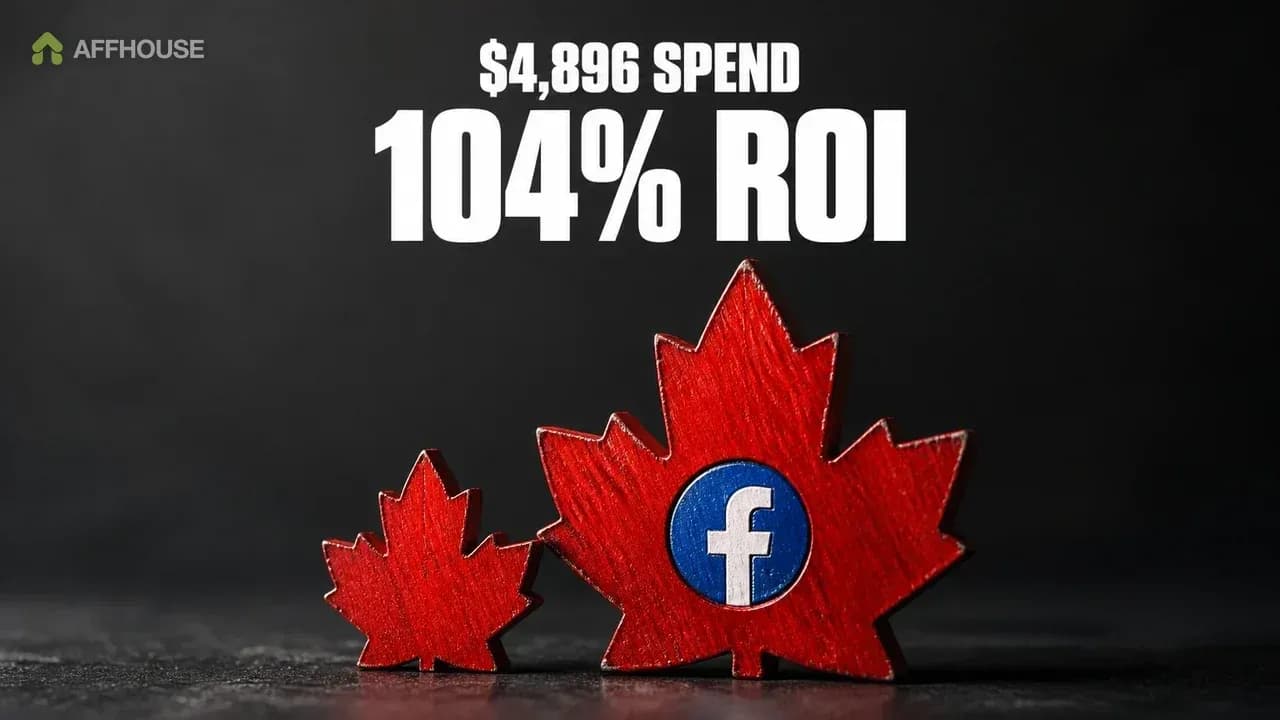
This casino affiliate marketing case covers one Facebook campaign for Slotier, a casino app offer, aimed at Canada outside Ontario from 24 February to 17 March 2025. A case study promoting the affiliate network One Partners reported $4,895.67 spent, $10,014.06 earned and $5,118.39 profit, a 104.55% ROI. None of these figures has been independently verified.
Results at a glance
According to the network, the campaign roughly doubled its media spend in three weeks.
| Metric | Value | Note |
|---|---|---|
| Spend | $4,895.67 | Network-reported, not independently verified |
| Revenue | $10,014.06 | Network-reported, not independently verified |
| Profit | $5,118.39 | Network-reported, not independently verified |
| ROI | 104.55% | Network-reported, not independently verified |
| Period | 24 Feb-17 Mar 2025, about three weeks | Network-reported, not independently verified |
| Traffic | Facebook, iOS and Android app offer, men 25+ | Network-reported, not independently verified |
ROI here is profit divided by spend: $5,118.39 / $4,895.67 = 104.55%, and revenue minus spend does equal the reported profit. No FTD count, CPA rate or payout per depositor was published.
Context
The figures come from a case study published in April 2025 about the affiliate network One Partners. It includes promotional plugs for the network and ends with an invitation to sign up with it, so treat it as sponsored marketing content that happens to contain numbers. It is useful as an example of an affiliate marketing casino campaign in a Tier-1 GEO, not as a benchmark.
The offer was Slotier, a casino app for iOS and Android. The source does not say which license the operator holds or how it was cleared to advertise in Canada. The network's stated reason for choosing Canada was payout level and a better-off audience; the trade-off, in most Tier 1 GEO launches, is usually pricier traffic than in cheaper markets.
For online casino affiliate marketing, the legal map matters more than the creative. Under section 207 of Canada's Criminal Code, a province may conduct and manage lottery schemes, including gaming, within its own borders, so each province sets its own rules. Ontario has run an open, regulated market since April 2022, where an operator needs AGCO registration and an operating agreement with iGaming Ontario before it can take players (see Ontario's open iGaming market by the numbers). The offer terms did not pay for Ontario traffic at all. The source does not say why, and it does not say whether the operator had either the AGCO registration or the iGaming Ontario agreement.
Quebec is a separate case. Its lottery corporation, Loto-Québec, describes its own site as the only legal gaming website in the province. The picture has also moved since the campaign: Alberta opened a regulated market on 13 July 2026, more than a year after this campaign ran. This is Canadian context, not guidance on US law; for the US picture, see Is online gambling legal in the US?.
What they did
The network ran a short test-then-scale campaign on Facebook with video creative and its own apps.
Audience and placement
The source lists the platform as "Facebook apps" and the placement as Facebook; we read this as app-install traffic. The audience was narrowed to men aged 25 and older. One week went to testing angles and hooks, and the rest of the period went to scaling what worked.
Creative
Video was the only format the network kept, cut vertically for phone feeds. Its working recipe was real slot gameplay, a visible emotional reaction and a hook in the first seconds of the clip.
According to the network, creatives should also follow a few other rules:
Language. Use separate versions in Canadian English and Quebec French rather than one generic English cut, and quote prices and bonuses in Canadian dollars.
Cast. Use ordinary-looking people from varied backgrounds rather than polished stock imagery.
Bonus framing. Present the bonus as a better playing experience, never as a way to earn money.
The team did test static ads first: bright images built on screenshots of popular slots. They did not convert and were dropped.
Setup
Campaigns used 1-3-1 and 1-5-1 structures, usually read as one campaign, three or five ad sets and one ad each, with budgets set at the ad-set level. The apps were the network's in-house builds. Spend ran through agency ad accounts, which the network said made it easier to scale.
Results
On the reported figures, the campaign's profit, the closest thing to casino affiliate earnings here, was $5,118.39 on $4,895.67 of spend. By our arithmetic, profit was about 51% of revenue, and spend averaged roughly $220-235 a day across the 22 calendar days.
What the numbers leave out is just as important. With no FTD count, cost per depositor cannot be calculated. There is no CPA rate, no approval rate after the operator's review, no retention data and no figure for chargebacks or rejected players. Without those, you cannot judge whether the result came from cheap traffic, a generous payout or a short lucky run. Our guide to EPC, CR, CPA, ROI and LTV covers why ROI alone hides most of that.
The offer terms add one more question. The cap was 20 FTDs, and the source does not say whether that was per day, per week or for the whole run. If it covered the whole run, $10,014 of revenue would imply about $500 per depositor, by our arithmetic. We cannot tell which reading is right.
What did not work, and the risks
One approach failed in testing, according to the network: bright static ads built on slot screenshots did not convert. It also advises against push-style "local man wins a car" stories, though it does not say it ran them.
The offer terms excluded a lot of traffic from payment, and that is where an affiliate's margin usually leaks. Unpaid under the terms:
fraud, chargebacks and multiple accounts;
incentivized (motivated) traffic;
any traffic from Ontario;
creatives that state the minimum deposit amount.
The paid event was a first-time deposit with a 20 CAD / 20 EUR minimum, and the offer paid nothing for depositors who then showed no activity.
Risks to weigh before copying the setup:
One sample. Three weeks, one offer, one source. No cohort data after March 2025.
Sponsored source. The network sells access to the same offers and apps it describes.
Platform policy. Meta allows online gambling ads only after the ad account is authorized, asks for evidence that the gambling is licensed by a regulator, bars targeting under 18, and applies the same rules to affiliate landing pages if the page promotes online gambling. The case does not explain how the ads were cleared.
Grey suggestions. The source also floated deepfake-style and celebrity creatives. Both carry legal and platform risk, and we do not recommend them.
Takeaways for casino affiliate marketing teams
The transferable lessons are about process, not about the exact numbers.
Read the offer terms before you spend. Geo exclusions (here, Ontario), the cap and its period, the paid event and the unpaid list decide how much of your traffic gets paid. Ask how the cap is counted. See CPA vs RevShare vs Hybrid for how FTD-based deals pay.
Lead with video, test statics cheaply. In this case statics lost; give them a small, fixed test budget rather than a week of spend.
Localize language, not stereotypes. Separate English and French cuts, local currency and real-looking people are concrete changes; national clichés are not.
Sell the product, not a payday. Present the bonus as part of the game, and make no promise of winnings.
Ask for FTD-level data. Request depositor counts, approval rates and rejection reasons from the network, not just a final ROI.
Check province and platform rules first. Confirm which provinces the operator may serve and that your ad account holds gambling authorization for Canada.
FAQ
Is casino affiliate marketing legal in Canada?
We did not find a Canadian rule that specifically governs affiliate promotion, so this article does not rule on whether online casino affiliate programs are legal. What the primary sources do show is that operators are regulated province by province. In Ontario, only operators registered with the AGCO and under an operating agreement with iGaming Ontario are in the regulated market, and Alberta opened a regulated market on 13 July 2026. In Quebec, Loto-Québec says its own site is the only legal gaming website in the province. Promoting an operator outside the local regulated or provincial framework carries legal and ad-platform risk, so check each province and take legal advice before you launch. This is a summary of public sources, not legal advice.
Why did the campaign exclude Ontario?
The campaign excluded Ontario because the offer terms did not pay for Ontario traffic. The source gives no reason. Ontario's regulated market requires AGCO registration and an iGaming Ontario agreement; the source does not say whether the operator had either.
What does 104.55% ROI mean in this case?
The 104.55% ROI means the campaign's reported profit of $5,118.39 was slightly more than its $4,895.67 spend. It is a network-reported figure, not independently verified, and it says nothing about cost per depositor or how long those players kept playing.
What creative worked for Canadian casino traffic?
Vertical video worked best for this campaign, according to the network: real slot gameplay, a visible emotional reaction and a hook in the first seconds, with separate Canadian English and Quebec French versions recommended. Static ads built on slot screenshots underperformed and were dropped.
Sources
Primary sources reviewed on 30 October 2026.
Alcohol and Gaming Commission of Ontario, Frequently Asked Questions - Internet Gaming
Alcohol and Gaming Commission of Ontario, Conduct and manage in the Criminal Code
Justice Laws Website, Criminal Code, section 207
Government of Alberta, Fact Sheet - Alberta iGaming, July 14, 2026
Loto-Québec, Online gaming
Meta Transparency Center, Ad Standards: Online Gambling and Games