
Tier 1, 2 and 3 countries: how GEO tiers work for affiliates
Tier 1, 2 and 3 are informal labels for grouping countries by purchasing power, ad prices and payouts. A consolidated list, where networks disagree, and how tiers work in iGaming.
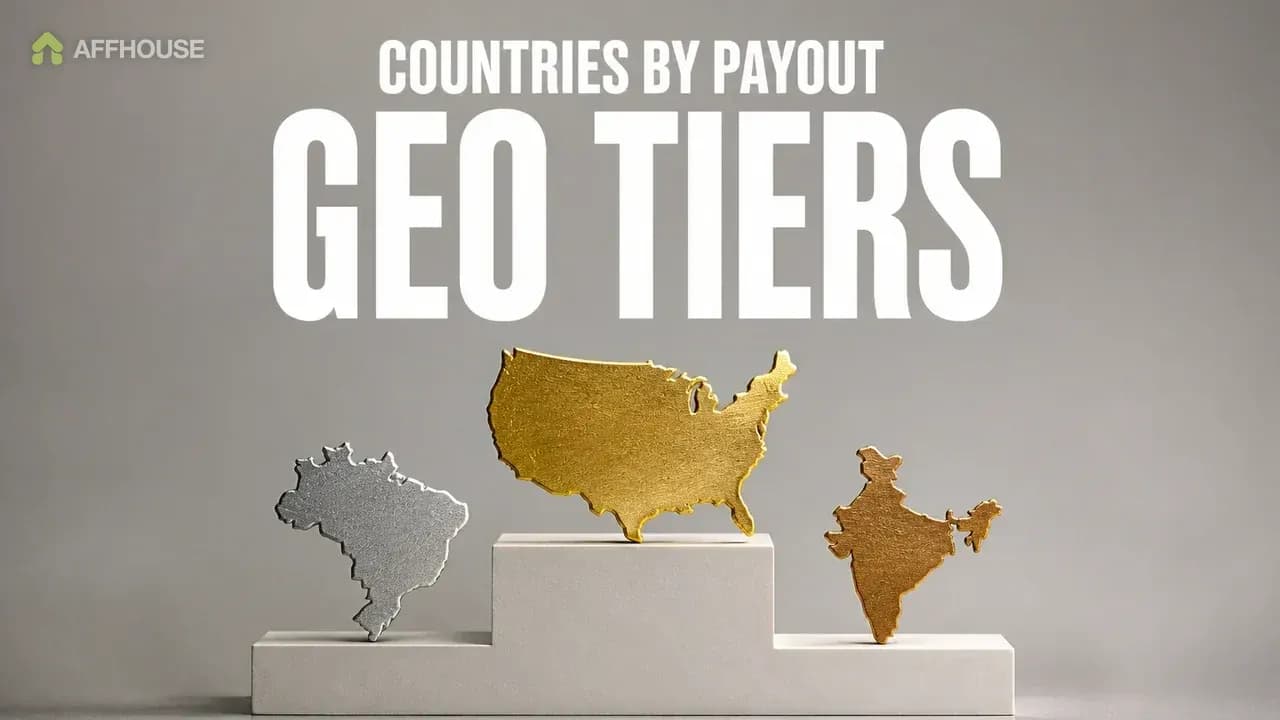
Tier 1 countries are the high-income markets where ad traffic costs the most and offers pay the most: the US, Canada, the UK, Australia, New Zealand and most of Western Europe. Tier 2 sits in the middle, and Tier 3 covers cheap, low-payout markets. The tiers are trade shorthand, not an official list.
Every ad and affiliate network draws its own version, so a country's tier depends on whose list you read. For casino and sportsbook offers, a second map matters more than wealth: where the product is legal and who may advertise it.
What are Tier 1 countries?
In advertising and affiliate marketing, the meaning is simple: "Tier 1" is the top price band of countries, where users spend the most online, inventory is priced highest and offers pay the most. Tier 2 and Tier 3 are the cheaper bands below.
The labels come from ad buying: networks price traffic by country, and a few bands make rate cards, offer caps and targeting presets easier to read. No regulator, statistics office or trade body maintains the list. (Immigration, streaming and export-control "tiers" are unrelated.)
The closest official yardstick is the World Bank's income classification. For its fiscal year 2027, effective July 1, 2026, an economy counts as high income when its gross national income per person (Atlas method) is above $14,375. Every country on the core Tier 1 list below clears that bar, the US included. So do Japan, South Korea, the UAE, Greece and Hungary, which network lists put in Tier 2, and Saudi Arabia, Qatar and Uruguay, which at least one list puts in Tier 3. Income is a filter, not the whole definition: ad prices, competition, language and payment habits decide the rest.
Tier 1, 2 and 3 countries list
There is no official list of all Tier 1 countries. The table shows the core that published network lists agree on and the countries where they split; check it against the list of the network or program you buy from.
| Tier | Commonly grouped here | Where lists disagree | What usually defines it |
|---|---|---|---|
| Tier 1 | United States, Canada, United Kingdom, Ireland, Australia, New Zealand, Germany, France, Italy, Spain, Netherlands, Belgium, Austria, Switzerland, Luxembourg, Sweden, Norway, Denmark, Finland | Poland, Czechia, Portugal, Slovenia, Iceland (Tier 1 on some lists, Tier 2 on others) | High income, highest CPMs and payouts, typically stricter ad, privacy and gambling rules |
| Tier 2 | Japan, South Korea, Singapore, Hong Kong, UAE, Greece, Cyprus, Malta, Hungary, Romania, Bulgaria, Croatia, Slovakia, the Baltic states, Türkiye, Brazil, Argentina | Mexico, Chile, Colombia, Uruguay, Israel, Saudi Arabia, Qatar, South Africa, Malaysia, Thailand (Tier 2 on some lists, Tier 3 on others) | Middle to high income, cheaper traffic than Tier 1, regulation and payments vary widely |
| Tier 3 | India, Pakistan, Bangladesh, Nigeria, Kenya, most of Central America, Cambodia, Laos | Indonesia, the Philippines, Vietnam, Egypt (sometimes Tier 2) | Lower income, cheapest traffic, lowest payouts, more payment friction and fraud |
Why the lists differ: each network builds its bands from its own auction prices and advertiser demand, which vary by ad format, vertical and language. Bands also drift as currencies, payment rails and laws change, and even official income groups move: in July 2026 the World Bank moved the Philippines and Vietnam up to upper-middle income.
Tier 1 countries
Tier 1 traffic is expensive, competitive and the most valuable per conversion. The English-speaking Tier 1 countries (the US, UK, Canada, Australia, Ireland and New Zealand) work as one language market; add French copy if you buy Quebec. The Tier 1 European countries, such as Germany, France, the Netherlands and the Nordics, are separate language markets that each need their own ads and landing pages. "Top Tier 1 countries" in buyer talk usually means the big English-speaking markets plus Germany and France. EU5, a market-research grouping, means the UK, Germany, France, Italy and Spain, all Tier 1.
Tier 2 countries
Tier 2 is the middle band: clicks cost less than in Tier 1, and many users still have money to spend. Teams often scale a proven funnel here. The band is wide, though. Japan and Argentina share a tier and almost nothing else: language, payment methods, ad rules and price levels all differ.
Tier 3 countries
Tier 3 offers volume at the lowest prices and the lowest payouts. The catch comes after the click: junk traffic and payment friction eat into that low price, and a heavy landing page can stall on an entry-level phone. Cheap clicks do not mean cheap results if few of them convert.
Tier 4 countries
Some networks add a Tier 4 for markets with almost no ad inventory or online spending. Most affiliates never buy there.
What changes between tiers
The tier mostly sets the economics of a campaign: moving down from Tier 1, ad prices and payouts fall, while localization, payment and fraud-filtering work grow. These levers move between Tier 1 and the cheaper bands:
Ad prices. Tier 1 audiences draw the most bidders at auction, which puts CPM and CPC at the top of the range. Still, a major tournament or holiday season can lift prices in one country, sometimes past a Tier 1 market.
Payouts. CPA rates and the long-term value of a RevShare deal follow what a customer is worth, so they are highest in Tier 1 and fall with each tier.
Competition. In Tier 1 you bid against operators' in-house teams and large agencies with bigger budgets. Those audiences are the most heavily targeted, so plan regular creative refreshes.
Localization. Each non-English market needs its own build of a creative, with local currency, idiom and visual cues, not a word-for-word translation.
Payments. Tier 1 audiences mostly pay by card or bank. Lower tiers lean on mobile wallets and local methods, so confirm the operator's cashier supports them before you buy traffic.
Traffic quality. Fraud and accidental clicks rise in cheaper GEOs, so budget for filtering and expect a share of conversions to be rejected.
There is no official "Facebook Tier 1 countries" list either: Meta and Google let you target by country and set their own rules for restricted categories. Google, for example, allows online gambling ads only in countries on its policy list, requires certification first, and asks for a valid local license for every region you target. Check current policy before you launch.
Tiers in iGaming: regulation beats wealth
In iGaming, the first question is not how rich a country is but whether the product is legal there and who may promote it. A Tier 1 country can be closed, licensed state by state, or open only to locally licensed operators. In practice, "Tier 1" in casino and betting means regulated, high player value and strict compliance.
United States. According to the American Gaming Association, legal sports betting was offered in 39 states plus DC at the close of 2025. A full range of online casino games was legal in only seven: Connecticut, Delaware, Michigan, New Jersey, Pennsylvania, Rhode Island and West Virginia. Nevada allowed online poker only. Maine passed iGaming legislation that became law in January 2026; it was not live at the close of 2025. A "US casino" campaign really runs in a handful of states. See our state-by-state guide for current status.
United Kingdom. The Gambling Commission holds licensed operators responsible for the third parties they contract with, including affiliates that market for them (Social Responsibility Code provision 1.1.2). Expect contract terms and compliance checks from the operators you promote.
Canada. Not one market. Ontario opened its own regulated market on April 4, 2022: private operators need registration with the AGCO and an operating agreement with iGaming Ontario before serving players in the province.
Lower tiers include grey markets with no local licensing or unclear rules. Licensed operators and reputable programs tend to avoid them, and ads there can breach platform policy; this guide does not cover buying there.
This is a summary of public regulatory sources (US figures as of the close of 2025), not legal or financial advice.
How to choose a tier
Choose a tier by matching it to your test budget, offer, licensing, language and payment options, not by click price alone. A media buyer often picks the GEO early, because it sets the price of every test that follows. Weigh these together:
| Factor | Points toward Tier 1 | Points toward Tier 2 or 3 |
|---|---|---|
| Test budget | Enough to buy meaningful data at high CPMs | Small budget, need many cheap tests |
| Offer and payout | High CPA or RevShare with strong player value | Low payout, volume-driven offers |
| Licensing | You promote operators licensed in a regulated Tier 1 market | You have confirmed the product is legal where you buy |
| Language | English creatives, or native-language skills in-house | Native speakers or trusted localization available |
| Payments | Card-first audiences | Offers that support local wallets |
For beginners, the cheapest GEO is rarely the easiest. Many US-based affiliates start with one regulated state or one English-speaking market, not a spread of cheap countries.
FAQ
What are Tier 1 countries?
Tier 1 countries are high-income markets with the most expensive ad traffic and the highest affiliate payouts. Lists usually include the US, Canada, the UK, Ireland, Australia, New Zealand and most of Western Europe. The grouping is informal: each ad network or affiliate program publishes its own version, and the edges differ.
Is the USA a Tier 1 country?
Yes, the USA is a Tier 1 country: it is Tier 1 on every network list we reviewed and a World Bank high-income economy. For iGaming, though, the label is not enough: sports betting and online casino are licensed state by state, and full online casino is legal in only a handful of states, as the iGaming section above shows.
What are Tier 2 countries?
Tier 2 countries are middle-to-high income markets where traffic is cheaper than in Tier 1 but players still have money to spend. Typical examples are Japan, South Korea, Central and Eastern Europe, the UAE, Brazil and Argentina. Many teams use Tier 1 and Tier 2 audiences together, scaling into Tier 2 once a funnel works.
What are Tier 3 countries?
Tier 3 countries are lower-income markets with the cheapest traffic and the lowest payouts, such as India, Pakistan, Bangladesh, Nigeria and much of Central America. They offer volume, but conversion rates, payment options and traffic quality are weaker, so results per dollar are often worse than the click price suggests.
Which tier is best for beginners?
No single tier is best for beginners. Pick the market whose language, rules and payment habits you understand, and where your budget buys enough conversions to judge a funnel. Cheap Tier 3 clicks can burn a budget on low-intent traffic, while a narrow Tier 1 test may teach you more for the money.
Are there Tier 4 countries?
Some networks use a Tier 4 for markets with almost no ad inventory, online spending or payment infrastructure; others fold those countries into Tier 3. Few offers accept that traffic, so the label matters mainly when you read a network's rate card.
Sources
American Gaming Association, State of the States 2026
UK Gambling Commission, Affiliates or third parties
iGaming Ontario, Ontario's new iGaming market to launch April 4, 2022
Google Ads policy, Gambling and games