
GGR up 615% on a modest budget rise: an operator's case
Fidel Group says Surebet 247 in Nigeria grew GGR 615% in about 18 months while its marketing budget rose 50-100%. What changed, and what affiliates can use.
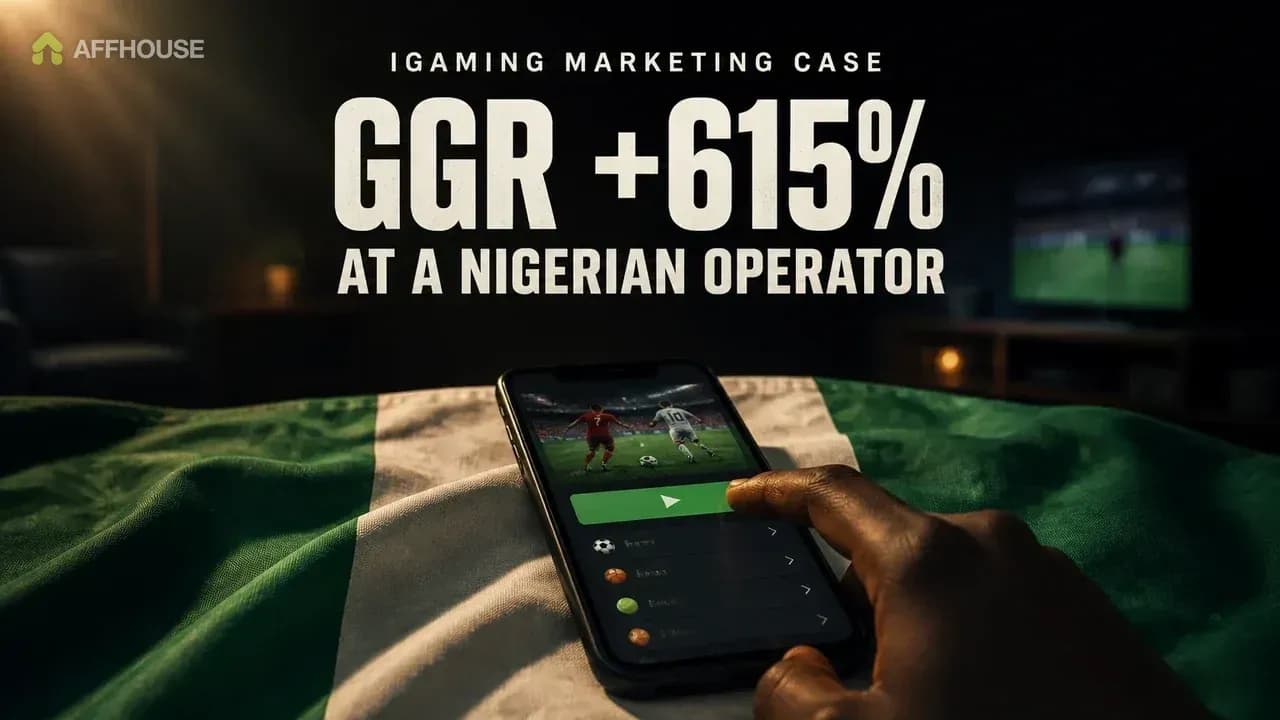
Fidel Group says that after buying the Nigerian betting brand Surebet 247 in October 2024, GGR rose 615% and the number of monthly deposits 445% within about 18 months, while the monthly marketing budget rose 50-100%. In iGaming marketing terms, the company rebuilt product and retention along with acquisition, rather than simply buying more traffic.
Results at a glance
| Metric | Value | Note |
|---|---|---|
| Brand and deal | Surebet 247, Nigeria, acquired October 2024 | Reported by Fidel Group, not independently verified. Brand trading since 2011 per the company; a 2023 business profile calls it about ten years old |
| Period | About 1.5 years after the acquisition | Reported by Fidel Group, not independently verified |
| GGR | +615% vs. the level at acquisition | Reported by Fidel Group, not independently verified; absolute GGR not disclosed |
| Deposits | +445% in the number of deposits per month | Reported by Fidel Group, not independently verified |
| Monthly marketing budget | +50% to +100% | Reported by Fidel Group, not independently verified |
| Payback on acquired traffic | Cut by about 70% from roughly 12 months | Reported by Fidel Group; the starting point is the company's own indirect estimate |
Every figure above is the company's own, from a trade-media case write-up that quotes Fidel Group, published in August 2026.
Context
The company describes Nigeria as a market with a large player base and strong local brands. NCC data for October 2025 counted about 142.0 million of 142.6 million active internet subscriptions on mobile networks. In our GEO tier guide Nigeria sits in Tier 3: large audiences, lower value per player.
The legal ground has also shifted. On 22 November 2024, Nigeria's Supreme Court held that the National Lottery Act applies only in the Federal Capital Territory and that lotteries elsewhere are for state law to regulate. Law firm commentary flagged new compliance questions for operators that work across several states.
Surebet 247 was not a startup. By the company's account it had more than a decade of trading behind it, a recognisable name and an existing player base, yet its growth had all but stopped. Fidel Group points to four weak spots rather than a single cause: marketing channels used well below their potential, retention that was shallow, processes that had to be built again, and a product that needed updating.
The obvious move for a buyer in that position is to raise acquisition spend. The company calls that the fastest option and, by its own assessment, probably the most expensive one.
What they did
The company describes changes along the whole path a player takes, from the first ad to what happens after the first deposit. Grouped by what they touch, as the company reported them:
The product
Sportsbook provider. The old sportsbook was not flexible enough for the local market, so it was replaced with one the company describes as having a better line, speed and stability.
Gamification. Features from an outside gamification provider were integrated, so players had more to do in the product than the usual bet-and-settle loop.
Native apps. iOS and Android apps went live. The company's case for them rests on the market being mobile-first with unreliable connections, where it sees speed and stability as part of what a player experiences.
Players after sign-up
Retention. Retention was rebuilt on a segmentation model, with separate communication flows for different player groups and a new loyalty programme.
VIP. The company also reorganised its VIP team and the way VIP players are managed.
Traffic
Acquisition was rebuilt alongside these changes. Media buying was brought in-house. The channel mix widened to a search-advertising funnel, app store optimisation, Facebook retargeting and in-app traffic; our guide to in-app advertising covers how that kind of traffic is bought. Creator-led channels came in as well: influencer campaigns and a separate tipster channel, meaning people who publish betting picks to a local audience.
As an iGaming marketing strategy, the company's stated aim was to fix what held the brand back rather than to lean on a bigger budget.
Results
The headline figure is easy to misread. A 615% increase means GGR ended at about 7.15 times its starting level, so "about seven times" is the plain-English version. The number of monthly deposits ended at about 5.45 times its starting level.
A 50-100% budget increase means the monthly budget ended at 1.5 to 2 times its starting point. Dividing the GGR multiple by the budget multiple gives roughly 3.6 to 4.8 times more GGR per unit of monthly budget than at the start. That is our arithmetic, and it assumes like-for-like periods: the company does not say whether the GGR figure is monthly.
For an affiliate, the payback figure matters most. By the company's indirect estimate, acquired traffic used to take about a year to pay for itself. A cut of about 70% would put it near three to four months. The company also says the project became profitable. Our guide to affiliate metrics explains how payback, ROI and player value fit together.
Not disclosed: absolute GGR, marketing spend in dollars or naira, margin, player numbers, how much each channel or change contributed, and whether the GGR comparison is monthly, quarterly or cumulative.
Risks and gaps
The company reported no failures, so this section sets out the limits of the case instead.
One source. Every figure is the company's account, carried in a single trade-media write-up. We did not find an independent announcement of the deal or the figures when we looked in October 2026.
No absolute baseline. Percentages on an unknown base cannot be compared with other operators.
A low starting point. A stalled brand has more room to grow than a healthy one, so part of the gain may be recovery rather than new growth.
Attribution. Six or more changes happened in the same period. The case cannot say which one drove which part of the result.
A loose claim. The company also said the result came without a bigger marketing budget, which contradicts its own 50-100% figure. We use the number.
Market risk. Regulatory change after the 2024 ruling can change the economics quickly.
Survivorship. Turnarounds that failed rarely get written up.
Takeaways for iGaming marketing and affiliates
This is an operator's turnaround, not a playbook for affiliates. What transfers to iGaming affiliate marketing is the logic behind the numbers.
Ask about payback before you price a deal. An operator whose acquired traffic pays back in a few months can afford a higher CPA or a richer RevShare than one waiting a year. See CPA vs RevShare vs Hybrid for how that changes the structure, and our player payback case for a worked example.
Check retention and VIP before you choose RevShare. For iGaming affiliates on revenue share, the operator's retention work decides how long your players keep earning.
Test the app in mobile-first GEOs. Download it, time the load on a slow connection, place a bet. A weak app burns the traffic you send.
Niche audiences have leverage. This operator bought tipster and influencer traffic directly, so affiliates with a betting audience can negotiate as a channel, not only as a link.
Do not read Tier 3 as Tier 1. Growth multiples from a stalled Nigerian brand say little about payback in a regulated US state.
Get numbers in writing. Before you scale with any operator, ask for cohort retention and payback data, not headline percentages.
FAQ
What is GGR in iGaming, and how is it different from revenue or profit?
Gross gaming revenue is the money players stake minus the winnings paid back to them. It is measured before bonuses, payment fees, taxes and operating costs, so it is a top-line figure, not profit. RevShare deals in affiliate programmes are usually paid on net gaming revenue, which is GGR after some of those deductions.
How did the operator grow GGR without a big budget increase?
According to the company, it rebuilt the product and retention: a new sportsbook provider, segmented player communication, a loyalty programme, a reorganised VIP function, gamification and native apps. It rebuilt acquisition at the same time, through in-house media buying, search, in-app traffic, retargeting, influencers and tipsters.
Can affiliates copy this approach?
Not directly. The changes were made inside the operator's product. What affiliates can use is the reasoning: operators with better retention and faster payback can pay more for traffic, so those are the numbers to ask for before agreeing terms.
Is the 615% figure independently verified?
No. It is the company's account, quoted in a trade-media case write-up along with the deposit, budget and payback figures. We did not find an independent announcement of the deal or the figures when we looked in October 2026, and the company did not disclose absolute values.
Sources
Checked October 2026. The summary of the Nigerian court ruling is for industry readers and is not legal advice. Case figures are company-reported, from a trade-media case write-up quoting Fidel Group, published in August 2026. This article summarises public information; the figures are not audited.
Templars, Supreme Court declares National Lottery Act invalid: implications for lottery businesses in Nigeria, November 2024
ThisDay, Nigeria's active internet subscribers hit 142.6m as mobile GSM maintains lead (NCC data for October 2025), December 2025
ThisDay, Deep dive into SureBet247's enduring business model, September 2023