
In-app advertising explained: Moloco, formats, iGaming rules
How in-app ads are sold and bought, which formats exist, what Moloco is, how optimisation and fraud work, and where gambling ads are allowed inside apps.
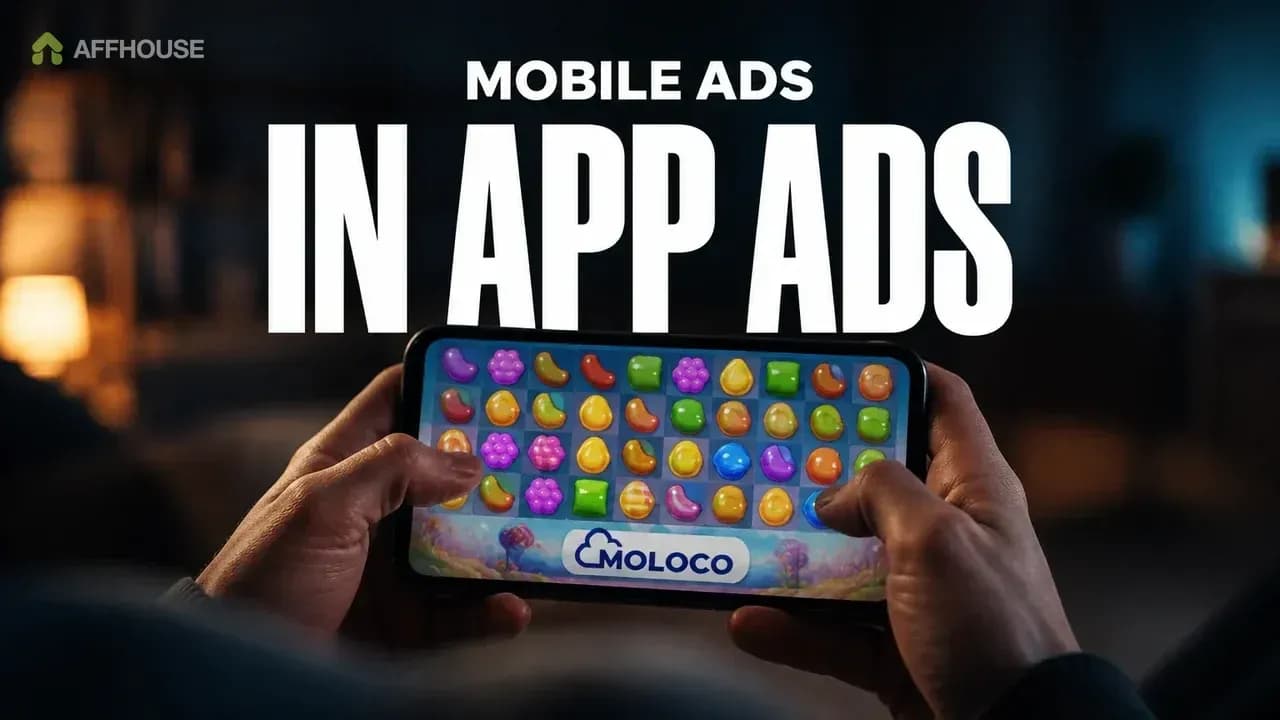
In-app advertising is paid advertising shown inside mobile apps and games: banners, video, rewarded ads and playable mini-games. It is bought through SDK ad networks and DSPs and targeted with device advertising IDs instead of cookies. For iGaming affiliates, mobile in-app advertising is a large channel with its own fraud risks and policy limits.
Below: the buying stack, formats, Moloco, optimisation, fraud and the app store rules. Short version of the rules: real-money gambling apps and ads run only for licensed operators, only where they hold a licence, and never in front of minors.
What is in-app advertising?
It is any ad a person sees while using an app, as opposed to an ad on a mobile website in a browser. That split decides how the ad is bought, targeted and measured.
Two groups make the market work. Publishers own free apps and games, add an advertising SDK and earn money each time an ad is shown or acted on. Advertisers pay to reach those users, usually to drive an app install, an action inside their own app, or plain reach.
Inside the app environment there are no third-party cookies to lean on. Targeting and attribution run on device-level identifiers instead:
Android relies on Google's advertising ID (GAID).
iOS relies on Apple's IDFA, and an app must get the user's explicit permission through App Tracking Transparency (ATT) before it can track them. Many users decline, so Apple also offers privacy-preserving attribution through SKAdNetwork and its successor, AdAttributionKit, which report installs and conversions in aggregated, delayed form.
Measurement therefore depends on SDKs and attribution partners, not pixels on a landing page, and US iOS buyers get thinner user-level data than on Android.
How in-app ads are bought: publishers, networks, SSPs and DSPs
An in-app impression passes through several layers before a buyer pays for it.
The publisher app runs one or more ad SDKs and decides where ads may appear: between levels, at the bottom of a screen, or as an opt-in reward.
Mediation and supply platforms sell that inventory. Many publishers use a mediation layer that asks several networks and exchanges to bid on each slot. An SSP or exchange packages the slot for programmatic buyers. Our DSP vs SSP explainer covers that split in detail.
SDK ad networks both sell inventory and run their own buying tools. Unity (which completed its merger with ironSource in November 2022), AppLovin, Mintegral, Liftoff (which merged with Vungle in 2021), Digital Turbine and Google AdMob are common names among in-app advertising platforms.
DSPs sit on top. A demand-side platform bids on inventory from many exchanges and networks at once and uses its own models to decide what each impression is worth.
The MMP (mobile measurement partner) records installs and in-app events and reports them back to whichever network or DSP drove them.
SDK network vs DSP
An SDK network sells inventory it reaches through its own SDK, with its own dashboard and often manual control over placements and bids. A DSP buys across many sources through one interface and leans on automated bidding. Many teams combine both.
Access is a practical hurdle. Large networks and DSPs set minimum budgets and their own onboarding rules for restricted categories such as gambling, which can include account approval steps. Thresholds vary by platform and change often, so ask each platform before you plan a test. If you are still deciding whether to work with a network or directly with brands, see CPA network vs ad network.
In-app ad formats
Most in-app ad formats fall into six groups, named much the same way across networks.
Banner. A strip at the top or bottom of the screen; AdMob's standard phone banner is 320x50. Cheap, high volume, usually bought on CPM and easy to ignore.
Interstitial. A full-screen ad shown at a natural pause, such as between game levels. Apple requires these to be clearly labelled as ads and to have an easy, visible close or skip button.
Video. Short clips, skippable or not, often shown as interstitials. Video is widely used by game advertisers to drive installs.
Rewarded. The user chooses to watch an ad in exchange for a bonus inside the app, such as a hint, a continue or a few gems. Opt-in views are usually watched to the end.
Playable. A short interactive demo that lets the user try a game before installing it. It shows the product directly instead of describing it.
Native. An ad built to match the app's look and feel and shown inline with its content, labelled as sponsored.
Buyers pay on CPM, CPI (cost per install) or CPA (cost per in-app action), depending on what the platform supports.
Some neutral examples: a puzzle game runs a rewarded video for another puzzle game; a sports news app shows an interstitial for a licensed sportsbook in a state where both are allowed; a card game promotes itself with a playable demo. A rewarded ad offering in-game coins for installing a real-money casino app is a poor example. It would reach players of any age inside a game, which is exactly what the gambling-ad rules below try to prevent (no gambling ads to users known to be under 18, none inside Designed for Families apps).
What is Moloco, and how do Moloco ads work?
What is Moloco? Moloco is an advertising technology company founded in 2013. Its co-founder and CEO is Ikkjin Ahn. The company calls itself an "AI-native performance advertising company" and runs two main businesses: Moloco Ads, for app marketers, and Moloco Commerce Media, for retailers and marketplaces that sell ads on their own sites. In 2021 it announced a $150 million Series C led by Tiger Global.
For media buyers, "Moloco ads" and "Moloco DSP" refer to the same thing in practice: a primarily mobile DSP that buys in-app inventory programmatically across many supply sources and sets bids with machine-learning models trained on install and post-install data.
Moloco's help centre lists the campaign goals:
User acquisition: optimise for installs, for a chosen in-app event (for example registration or first deposit), or for ROAS (return on ad spend).
Re-engagement: reach people who already installed the app, optimising for clicks, app opens, in-app events or ROAS.
Event and ROAS goals only work if your MMP sends Moloco postbacks for those events, including revenue for ROAS. Moloco's own documentation says ROAS campaigns take longer to optimise than install campaigns.
Buyers like event-based bidding because it chases depositors rather than cheap installs. The model, not the buyer, decides most bids, so check which placement and allowlist controls your account actually gets.
As of October 2026, Moloco's iGaming page markets Moloco Ads to iGaming and prediction-market apps and describes curated publisher allowlists, geo-targeting controls and placement-level transparency. Whether a given account and app are approved is a separate question, answered by Moloco's current policy and review, not by forum reports.
Optimisation, tracking and measurement
In-app campaigns learn from the events you send them. Without post-install data, a network can only optimise for installs, and installs are a weak proxy for a depositing player.
Moloco's goal list implies a ladder most platforms share:
Installs (CPI) come first, because a new campaign has no other signal in volume.
An event goal, such as registration or first deposit, takes over once the MMP reports that event often enough to learn from.
ROAS is the last rung. It needs steady deposit and revenue data, and Moloco notes it takes longer to optimise.
Every rung depends on an MMP such as AppsFlyer, Adjust or Singular passing events back to the network as postbacks. Our postback tracking guide explains how those callbacks are set up and why event names must match on both sides.
Practical rules for reading the results:
Judge cohorts, not clicks. Accidental taps on full-screen ads inflate CTR without producing players. Early cohort quality, meaning registrations and first deposits in the first days after install, is the fastest signal. Confirm it against later cohorts before scaling.
Respect the learning phase. Changing bids, budgets and creatives every day resets what the model has learned. Tiny tests rarely produce enough events to train on.
Cut sources fast. On networks with placement control, review performance by app and turn off publishers that send installs without events.
Fraud and traffic quality in-app
Wherever installs are paid, someone tries to fake them, so ad fraud is part of in-app economics. It usually shows up in your attribution data first. Three checks catch most of it:
Click-to-install time. A gap of a few seconds between click and install suggests click injection: a malicious app fires a click just as an install starts, to steal credit for it. A very long, flat spread of gaps suggests click spam, where huge numbers of fake clicks are fired in the hope that some match organic installs.
Concentration. A large share of installs from a single publisher app, device model, OS version or IP range is unusual for genuine traffic.
Installs without events. Volume that never registers, deposits or comes back points to non-human or no-intent traffic, whatever the CTR looks like.
The usual causes: bots and emulators posing as phones, spoofed or proxied devices that make one machine look like many users in a premium country, and install farms of real phones.
The defence is documentation. Keep click and install IDs, timestamps and event logs, compare them with your MMP's fraud reports, send the evidence to the network or agency with a specific refund or block request, and exclude the offending placements.
In-app advertising rules for iGaming
Gambling is one of the most restricted categories in mobile, with rules at three levels.
Google Play. Real-money gambling apps are allowed only in the countries Google lists and only for approved operators. The developer must complete Google's application process and hold a valid licence for each country or state where the app is distributed, covering the specific gambling product it offers. The app must block users outside those areas and block under-age users, be free to download, and show responsible-gambling information. A separate section covers ads for gambling inside Play apps. An app may carry them only if it does not show them to users known to be under 18 and is not enrolled in Designed for Families or aimed at under-18s. It also cannot itself offer simulated gambling such as social casino, and the ad's landing page must show responsible-gambling information.
Apple App Store. Guideline 5.3.4 says apps offering real-money gaming, including sports betting, poker, casino games and horse racing, must have the necessary licences and permissions where the app is used, must be geo-restricted to those locations, and must be free on the App Store. Apple also requires ads to fit the age rating of the app that shows them.
Networks and DSPs. Each platform sets its own gambling policy: whether it accepts the category, which countries and app ratings qualify, and what approval an advertiser needs. These policies change, sometimes without notice, in both directions.
For US buyers, the store rules sit on top of state law. Online casino and sports betting are licensed state by state, so a campaign has to match the advertiser's licence footprint. Our overview of whether online gambling is legal in the US tracks that map. This section summarises platform policies as of October 2026 and is not legal advice.
The practical rule: work only with licensed operators, check the current policy page of every network before you plan a budget, and keep a dated copy of what it said.
FAQ
What does "in-app ads" mean?
In-app ads are ads shown inside a mobile app or game, rather than on a website. They appear as banners, full-screen interstitials, video, rewarded ads, playable demos or native placements, and are paid for on CPM, CPI or CPA.
How does in-app advertising work?
The app runs an advertising SDK. When an ad slot opens, networks and DSPs bid in an auction, using the device's advertising ID and context to value the impression. The winning ad is shown, and an MMP attributes any install or event back to the buyer.
How much does in-app advertising pay?
Revenue from in-app ads depends on format, country, app category and season. Full-screen and rewarded formats generally earn publishers more per thousand impressions (eCPM) than small banners, because they hold full attention. Real eCPM shows in each network's dashboard; mediation lets networks compete for every slot.
What kind of company is Moloco?
Moloco is an advertising technology company founded in 2013. Its main product, Moloco Ads, is a machine-learning DSP that buys mostly mobile in-app inventory for app marketers. It also runs Moloco Commerce Media, which helps retailers and marketplaces sell ads on their own platforms.
Can you advertise gambling apps in-app?
Sometimes. Google Play and the App Store only allow real-money gambling apps from licensed operators, geo-restricted to licensed areas. Each network or DSP then decides whether it accepts gambling ads, where, and through which accounts. Check the current policy of each platform before spending.
Sources
Google Play Console Help, Real-Money Gambling, Games, and Contests policy
Google AdMob Help, Ad formats
Google for Developers, AdMob banner ad sizes
Moloco Help Center, Choose the right campaign goal
Liftoff and Vungle, Liftoff and Vungle join forces