
Brazil sports betting after its first regulated year
Brazil's 2025 licensed betting market in numbers: 79 operators, R$37 billion in GGR, R$9.95 billion in federal tax, 25,000 blocked sites and a levy rising to 15%.
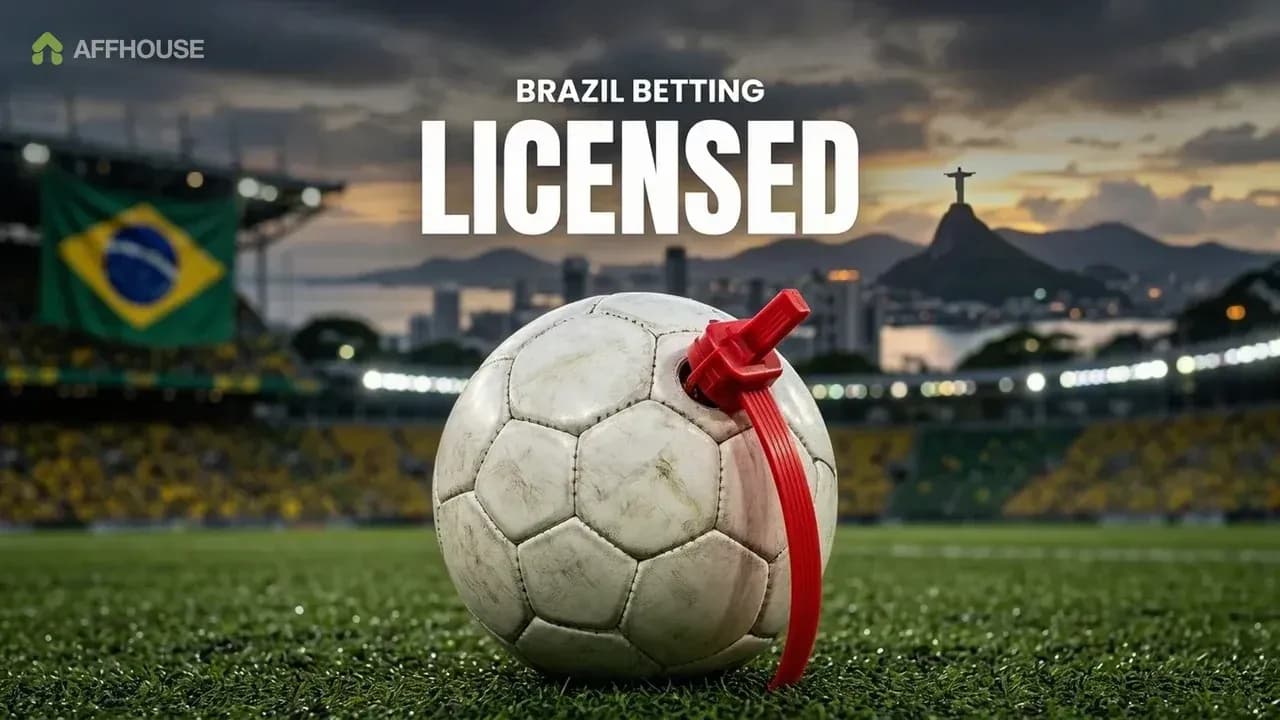
Brazil's sports betting market operated under federal licences for the first full year in 2025. The 79 authorised companies reported about R$37 billion in gross gaming revenue from 25.2 million bettors. Federal tax collection reached about R$9.95 billion, more than 25,000 illegal sites were blocked, and Congress then raised the 12% GGR levy in steps to 15% by 2028.
Results at a glance
| Metric | Value | Note |
|---|---|---|
| Authorised companies | 69 in February 2025; 79 reporting for full-year 2025 | Ministry of Finance (SPA) |
| Licence | R$30 million per authorisation, 5 years, up to 3 brands | Each extra set of brands needs another fee |
| Gross gaming revenue, 2025 | About R$37 billion (R$36.96 billion) | Bets minus prizes, as reported by operators to the SPA |
| Federal tax collected, 2025 | About R$9.95 billion | As reported in the Ministry's January 2026 release; includes R$4.5 billion from the 12% GGR levy |
| Illegal sites blocked | More than 25,000 by end 2025 | Blocked with the telecoms regulator Anatel |
| GGR levy | 12% in 2025; by statute 13% in 2026, 14% in 2027, 15% from 2028 | Complementary Law 224 of December 2025; the 90-day rule sets when each rise takes effect |
Period: 1 January to 31 December 2025, unless noted. Figures are official unless labelled as reported by a third party.
Context: Brazil sports betting before 2025
For about six years, sports betting in Brazil was legal on paper and unregulated in practice. Law 13,756 of December 2018 created fixed-odds betting as a federal lottery product but left the operating rules to future regulation, and that regulation did not arrive for years. In the meantime, offshore operators served Brazilian players under foreign licences, since no Brazilian licence existed.
Law 14,790 of December 2023 closed that gap. It made the Ministry of Finance responsible for authorising operators, collecting a levy on their revenue and setting player-protection rules.
The transition ran through 2024. The ministry published its licensing rules in May 2024 and, from October 2024, suspended betting companies that had not applied for authorisation. Companies that had applied could carry on during the transition, until the full regime started on 1 January 2025. Brazil was not the only large market opening around then; Ontario's first years after regulation offer a useful comparison.
What they did: Brazil's betting regulation step by step
Brazil's gambling regulator is the Secretariat of Prizes and Bets (SPA), part of the Ministry of Finance. It authorises operators, receives their transaction data through its SIGAP reporting system, supervises advertising and coordinates enforcement. The sequence:
May 2024: licence rules. Ordinance SPA/MF 827/2024 set the conditions for a Brazilian gambling licence. Each authorisation costs R$30 million, paid upfront, runs for five years and covers up to three brands, all operating on .bet.br domains. A company that wants more brands pays another fee. For how this compares with other regimes, see our guide to online gambling licenses.
October 2024: suspension of non-applicants. Operators that had not applied lost the right to keep serving Brazilian players.
December 2024: provisional authorisations. Ordinance SPA/MF 2,104 of 30 December 2024 let applicants that were still completing the process operate provisionally.
1 January 2025: full regime. Only authorised companies could take bets. On 11 February 2025, the SPA issued 21 more definitive authorisations, raising the definitive count from 14 to 35. Another 34 companies held provisional ones, for 69 in total.
Through 2025: enforcement. The SPA sent illegal domains to Anatel for blocking, asked payment firms to report and close accounts linked to unlicensed operators, and opened cases against influencers promoting illegal bets.
October 2025: social-benefit restriction. Ordinance SPA/MF 2,217/2025 and Normative Instruction 22/2025 barred Bolsa Família and BPC recipients from betting, to comply with a Supreme Court (STF) injunction.
December 2025: self-exclusion and tax. A centralised self-exclusion platform went live on 12 December. On 26 December, Complementary Law 224 raised the state's share of GGR.
Results
Market size. The 79 authorised companies reported about R$37 billion in gross gaming revenue for 2025, meaning stakes minus prizes. That works out to roughly R$1,460 of GGR per bettor across the year (our arithmetic). The SPA counted 25.2 million people who placed at least one bet, up from 17.7 million in the first half. Men made up 68.3% of bettors. The largest age group was 31 to 40 (28.6%), but 18 to 24-year-olds were 22.7%.
Tax take. As reported in the Ministry's January 2026 release, the Receita Federal collected about R$9.95 billion from the sector in 2025, counting corporate income tax, social contributions and the 12% GGR levy. The levy alone brought in about R$4.5 billion. The same release also listed about R$2.5 billion in licence fees and R$95.5 million in supervision fees.
Enforcement. By the end of 2025, more than 25,000 illegal betting sites had been blocked with Anatel, up from 15,000 at mid-year. Payment monitoring produced 1,255 reports from 54 financial and payment institutions, and 550 bank accounts were closed, 265 of them identified as belonging to illegal operations. The SPA had 132 proceedings open involving 133 betting brands, 80 of them heading toward penalties.
Advertising. Working with the ad self-regulator Conar and the Conselho Digital do Brasil, the SPA ran 412 inspections of digital influencers. They led to the removal of 324 profiles and 229 posts.
Player protection. In its first 40 days, the self-exclusion platform received more than 217,000 requests. Loss of control or mental health was the most cited reason (37%), and 73% of users chose an indefinite exclusion.
What did not work
The tax line kept moving. In June 2025 a provisional measure on investment taxation (MP 1,303) also covered betting; Brazilian press reported it would have lifted the levy. It lost effect without becoming law, per the Chamber of Deputies' record. Lawmakers then raised the levy through Complementary Law 224 instead: 13% in 2026, 14% in 2027 and 15% from 2028, with the extra share going to social security. The 90-day rule for tax increases applies, and the Receita Federal estimates the change adds R$255 million in 2026 and R$1.25 billion in 2028. That path is still far gentler than a high-tax model like New York's mobile sports betting tax.
Who may bet narrowed. The Bolsa Família and BPC restriction came from the courts, not the original rules, and its scope was contested at the Supreme Court. In its 20 August 2026 release, the ministry listed recipients of Bolsa Família, BPC, debt-renegotiation programmes and Fies student loans as barred from opening or keeping an account. Operators must close a flagged account within three days and return the balance. More than 3 million people had been blocked since October 2025.
The "ban" headlines were mostly proposals. No nationwide betting ban took effect; the adopted measures are the ones listed above. The main advertising bill, PL 2,985/2023, passed the Senate on 28 May 2025. Instead of the original total ban, it would bar athletes, artists and influencers from betting ads, limit broadcast and online ads to 19:30 to midnight, and restrict stadium boards to official sponsors and shirt brands. It reached the Chamber of Deputies in June 2025, where its record shows it awaiting the Speaker's dispatch; we found no record of it becoming law as of October 2026.
The illegal market did not disappear. More than 25,000 blocked sites show the SPA kept finding new domains through the year; the ministry gave no estimate of the illegal market's share.
2026 so far. By statute the levy is 13% this year, with the start date set by the 90-day rule. The social-programme restriction now also covers debt-renegotiation programmes and Fies borrowers; the Ministry of Finance described the scope on 20 August 2026.
Takeaways for affiliates
Promote only authorised brands. Check every operator against the SPA's list of authorised companies before sending traffic. Unlicensed brands are blocked, and payment firms close their accounts.
Model the levy into your deals. Operators' share of GGR falls from 88% to 85% by 2028, which squeezes the net revenue behind RevShare and CPA terms. Expect operators to renegotiate.
Budget for advertising rules that may tighten. Influencer content is already under inspection. If PL 2,985/2023 passes, influencer and time-of-day limits would apply to every partner's promotion.
Expect a smaller, verified audience. Social-programme holders are now screened out, so registration and FTD rates on mass-market traffic may drop.
Treat Brazil as its own geo. Sports betting in Brazil is usually priced as a Tier-2 geo, but its rules changed several times in one year; see how GEO tiers shape pricing, and re-check the rules before each campaign.
FAQ
Is sports betting legal in Brazil?
Yes, through authorised operators. As of October 2026, fixed-odds betting is legal under Law 14,790/2023 only with companies authorised by the Ministry of Finance, using .bet.br sites. The regulated market opened on 1 January 2025; unlicensed sites are illegal and are blocked.
How much does a Brazilian betting licence cost?
R$30 million per authorisation, paid upfront. It is valid for five years and covers up to three brands. More brands require another authorisation fee. Operators also pay supervision fees and the GGR levy.
Who regulates betting in Brazil?
The Secretariat of Prizes and Bets (SPA) of the Ministry of Finance. It grants authorisations, collects operator data, supervises advertising and player protection, and asks Anatel to block illegal sites. Under Brazil's betting regulation, the Receita Federal handles tax.
What taxes do betting operators pay in Brazil?
In 2025 operators paid 12% of GGR as a levy, plus normal corporate taxes. Complementary Law 224/2025 raises the levy, by statute, to 13% in 2026, 14% in 2027 and 15% from 2028, with each rise subject to the 90-day rule for tax increases. Rules checked October 2026.
Sources
Rules checked 30 October 2026. This article summarises Brazilian law and regulation for industry readers; it is not legal advice.
Ministry of Finance, one year of the regulated market, January 2026
Ministry of Finance, first-half 2025 figures, August 2025
Ministry of Finance, 21 definitive authorisations, February 2025
Ministry of Finance, licensing rules (Ordinance 827), May 2024
Ministry of Finance, suspension of non-applicants, September 2024
Ministry of Finance, social-benefit restriction, October 2025
Ministry of Finance, social-programme holders, August 2026
Receita Federal, Technical Note Cetad/Coest 009/2026 on Complementary Law 224/2025
Chamber of Deputies, MP 1,303/2025 record
Chamber of Deputies, PL 2,985/2023 record
Federal Senate, PL 2,985/2023 bill page and Senate vote, May 2025