
Better Collective: from affiliate to listed media group
How Better Collective grew from a two-founder affiliate project into a listed sports media group with €337m in revenue, and what its acquisitions and reset teach affiliates.
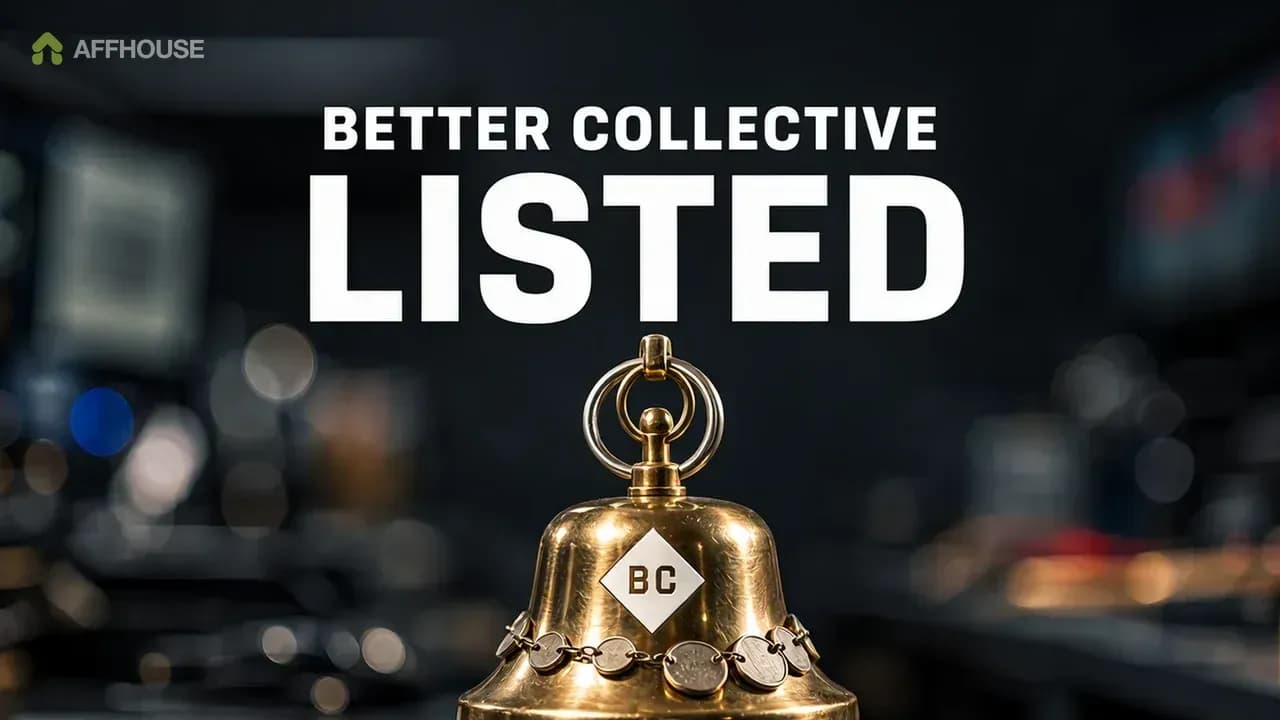
Better Collective A/S, headquartered in Copenhagen, grew from a two-person affiliate project started in 2004 by Jesper Søgaard and Christian Kirk Rasmussen into a sports media group listed in Stockholm and Copenhagen. It reported €337 million in revenue and €102 million in EBITDA before special items for 2025, after more than 35 acquisitions since 2017.
Results at a glance
| Metric | Value | Note |
|---|---|---|
| Revenue, 2025 | €336.7m | Down 9% from €371.5m in 2024; organic growth was -11% |
| EBITDA before special items, 2025 | €102.1m (30% margin) | 2024: €113.4m. Q4 2025 was the company's best quarter on this measure |
| Revenue, 2021 to 2024 | €177.1m to €371.5m | Reported growth, includes acquisitions; organic growth was -2% in 2024 |
| Revenue mix, 2025 | Revenue share 47%, CPA 24%, subscription 5%, other 24% | "Other" is mostly sponsorships and CPM advertising |
| Deals | 35+ acquisitions since 2017 | Company figure |
| Audience | 450m+ monthly visits, 112m+ monthly unique users | Company-reported, not independently audited |
All figures are from the Better Collective Annual Report 2025 (period to December 31, 2025) unless noted. Last updated October 30, 2026.
Context
Søgaard and Rasmussen started Better Collective in 2004; the company calls its beginning a "two-person initiative". Today it is a Danish public limited company with its registered office in Copenhagen. As of December 31, 2025, the two co-founders were still its largest shareholders, each holding 17.22% through holding companies. BLS Capital held 14.80%.
The shares have traded on Nasdaq Stockholm since June 8, 2018. A second listing on Nasdaq Copenhagen followed on November 17, 2023. For an affiliate, the listing mattered less as a badge than as a tool: it gave the company shares it could use to pay for acquisitions. Debt funding sits alongside that: in September 2025 the group renewed a three-year €319 million credit facility with Nordea and Nykredit.
Better Collective is one of a handful of affiliate businesses that reached the public markets. Gambling.com Group is the closest comparison.
What Better Collective did
A portfolio of brands, not one site
Better Collective describes itself as a House of Brands: global titles such as HLTV and FUTBIN sit next to country sites written around local sports, rules and betting habits, in more than 30 languages. The current line-up includes HLTV, FUTBIN, AceOdds, Action Network, Playmaker HQ, The Nation Network and Bolavip. When one site loses rankings or one market changes its rules, only part of the revenue base is exposed.
Better Collective acquisitions: buying growth
From 2017 the company used acquisitions as its main growth engine. The largest deals opened new audiences rather than adding more of the same:
HLTV (February 2020): the Counter-Strike news and stats site, for €26.4 million upfront and up to €8.1 million in earn-outs.
Action Network (May 2021): a US sports betting media and tools brand, for $240 million on a cash and debt-free basis. The company called it the largest acquisition in its history.
FUTBIN (April 2022): an EA Sports FC community site, for up to €105 million: €70 million in cash upfront, €5 million in shares and up to €30 million in earn-outs over two years.
Playmaker Capital (closed February 2024): a sports media group with brands in Latin America and Canada, paid in cash and new Better Collective shares. It is a different business from Playmaker HQ, an earlier US purchase covered below.
Better Collective, Action Network and the revenue-share bet
The May 2021 Action Network deal was the company's biggest purchase and became the centre of its US business. From 2022 the company moved its North American sportsbook deals away from upfront CPA toward revenue share, which pays over the life of each player instead of at sign-up. In 2025, North American CPA revenue fell by about half, to €20.6 million, while the region delivered about €17 million of pure revenue share, above the company's own €10 to 15 million expectation. The trade-offs between the two models are covered in our guide to CPA vs RevShare vs hybrid deals.
Products on top of content
The company also sells things that do not depend on a click-out. Subscriptions, most of them sold in North America, brought in €18 million in 2025. It launched Playbook, an AI betting tool that sits inside its media sites, in September 2025, and the FanReach advertising product in early 2026.
Results
Revenue more than doubled in three years: €177.1 million in 2021, €269.3 million in 2022, €326.7 million in 2023 and €371.5 million in 2024. EBITDA before special items rose from €55.8 million to €113.4 million over the same period, then eased to €102.1 million in 2025.
North America brought in €93.1 million in 2025, about 28% of group revenue. Its EBITDA margin before special items rose to 28% from 16% in 2024, which the company ties to its cost-efficiency programme and the growing share of recurring revenue share. After Brazil's new licensing regime, the company says all of its revenue now comes from regulated markets.
The latest move is into prediction markets. In March 2026 the company announced dedicated prediction-market editorial hubs, with Action Network as the main destination, and said it already worked with prediction-market operators. As of October 30, 2026, the newest step is Prediction Pro, a subscription product for that audience launched on October 19. For background, see how prediction markets work.
What did not work
Growth from deals stopped hiding weak organic growth. Organic revenue fell 2% in 2024 and 11% in 2025. Brazil's new regulation, in force from January 1, 2025, restricted bonus offers and cut the bottom line by about €22 million that year, less than the €35 to 55 million the company had warned of.
Some acquisitions underdelivered. In 2024 the price for Playmaker HQ, a US talent-led media business, was renegotiated from $54 million to $25 million, and the group booked an €18 million goodwill impairment.
The company responded with a €50 million annual cost-efficiency programme that started in October 2024 and, by its own account, was fully delivered in 2025. Average headcount fell from 1,773 in 2024 to 1,504 in 2025. At the end of April 2025 Rasmussen joined Søgaard as co-CEO, and the group was reorganised into three global business units: Publishing, Paid Media and Esports. Near-term priorities are now organic growth, debt reduction and share buybacks rather than new deals; net debt stood at 2.53 times EBITDA before special items at year-end.
The annual report also names AI-driven changes in search as a possible risk to future revenue share and CPA in Publishing, while stating that the company has so far seen no effect on its traffic. Catena Media's US story is a contrasting case.
Takeaways for affiliates
Spread risk across brands and markets. In 2025 Better Collective absorbed a Brazilian rule change and a low sports win margin, which it puts at about €17 million, and still earned €102 million in EBITDA before special items. No single site or country carried the group.
Treat revenue share as a deferred asset. Better Collective moved its US deals to revenue share from 2022 and says it now holds a large, not yet fully recognised revenue-share base. Plan cash flow for the lag between sign-up and payout before you switch.
Add income that does not depend on a click-out. Subscriptions, sponsorships and advertising were over a quarter of 2025 revenue.
Buy audiences you cannot build. HLTV and FUTBIN brought esports and gaming communities that publishing alone would not have reached.
Structure deals with earn-outs. The Playmaker HQ renegotiation shows why paying part of the price on performance protects the buyer.
Review the structure after a run of deals. Better Collective merged its regional set-up into three global business units after eight years of acquisitions. A smaller group can check for overlapping teams and tools after two or three deals, not eight.
This is a company case study based on public reports, not investment advice.
FAQ
Who owns Better Collective?
Better Collective is a public company. As of December 31, 2025, its co-founders, Jesper Søgaard and Christian Kirk Rasmussen, each held 17.22% of the shares through holding companies, BLS Capital held 14.80%, and the company held 5.27% as treasury shares. Other shareholders held the rest.
Is Better Collective a public company?
Yes. Better Collective A/S has been listed on Nasdaq Stockholm since June 2018 and on Nasdaq Copenhagen since November 2023, under the ticker BETCO. Its market value changes daily, so check the exchange for a current figure.
How does Better Collective make money?
Mostly from performance marketing. In 2025, 47% of revenue came from revenue share with sportsbooks and casinos and 24% from CPA payments. Subscriptions added 5%, and sponsorships and advertising made up most of the remaining 24%.
What is Action Network and how is it linked to Better Collective?
Action Network is a US sports betting media and tools brand. Better Collective bought it for $240 million in May 2021. As of March 2026, the company named Action Network the main destination for its prediction-market content hubs.
Sources
Better Collective, Annual Report 2025, February 25, 2026
Better Collective, Annual Report 2025 release and 2026 outlook, Nasdaq
Better Collective, acquisition of HLTV.org, February 28, 2020
Better Collective, acquisition of Action Network for 240 mUSD, May 3, 2021, and completion, May 28, 2021
Better Collective, acquisition of FUTBIN, April 2022
Better Collective, completion of the Playmaker Capital acquisition, February 2024
Better Collective, expansion into prediction markets, March 2026
Better Collective, company announcements on MFN, including the Prediction Pro launch of October 19, 2026