
Meta Andromeda: what changed in ad delivery and how to adapt
Meta Andromeda picks a few thousand candidate ads out of tens of millions before ranking. What Meta has published, what buyers report, and how affiliates should adjust.
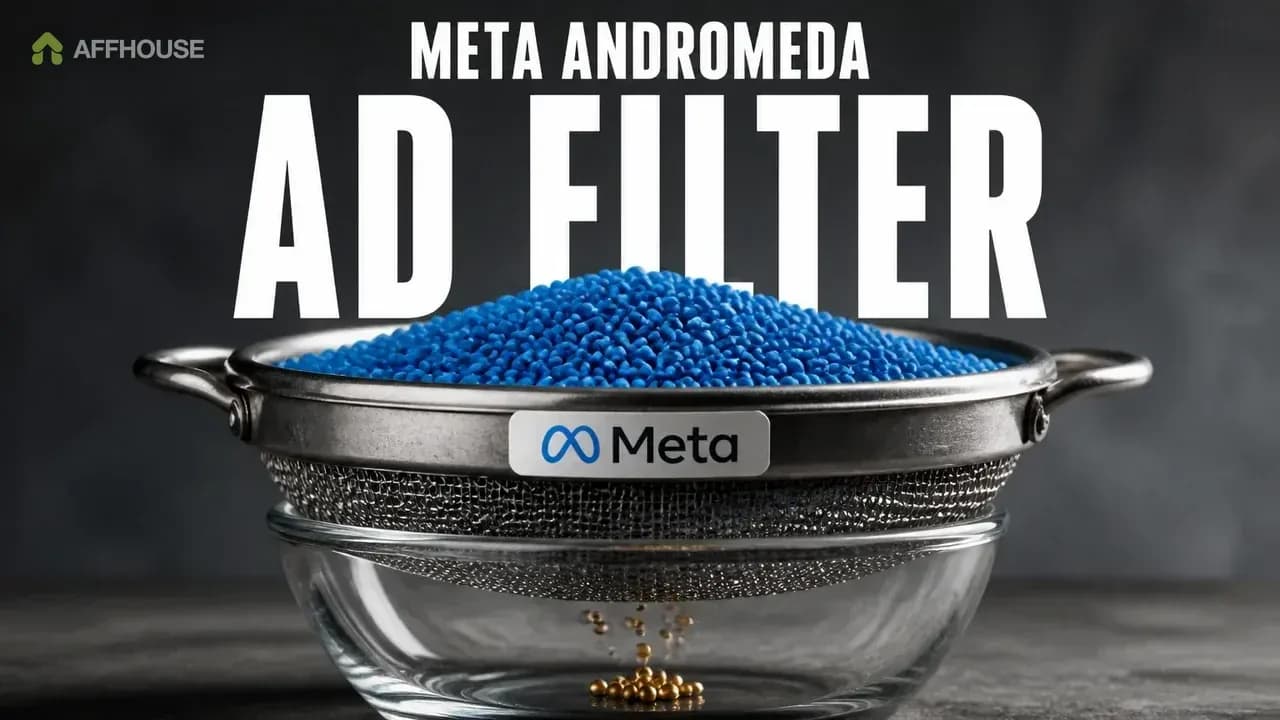
Meta Andromeda is the ad retrieval system Meta began introducing in the second half of 2024. Before the ranking stage decides which ad a person sees, Andromeda narrows tens of millions of potential ads to a few thousand candidates. For buyers on Facebook and Instagram, distinct creative concepts now do more of the work than narrow audience settings.
Below, Meta's published facts are kept apart from buyer practice, then applied to affiliate campaigns, including regulated offers.
What is Meta Andromeda?
Meta Andromeda is the retrieval system in Meta's ad delivery, which Meta calls its "proprietary machine learning (ML) system design for retrieval in ad recommendation." It was made public in a Meta Engineering post on December 2, 2024. People often call it the Andromeda algorithm, but Meta presents it as a system: a deep neural network plus the hardware and indexing built around it.
Meta's ad delivery runs in stages. Retrieval comes first and picks a few thousand relevant ads out of tens of millions. Ranking follows: larger models estimate what each remaining ad is worth to the person and to the advertiser, and choose what is shown. Andromeda is the retrieval stage. Meta's newer ranking model, the Generative Ads Recommendation System (GEM), works after it, as CFO Susan Li described on the Q2 2025 earnings call.
What Meta says Andromeda changed:
Model size. A 10,000x increase in model capacity at retrieval, aimed at more personalized selection.
Hardware. Meta built the model around NVIDIA Grace Hopper Superchips. It also names its own MTIA chips in the hardware co-design and lists closer integration with MTIA as a next step.
Indexing. Ads sit in a hierarchical index with several layers, so a much larger pool can be searched quickly.
Results. A 6% gain in recall and an 8% gain in ad quality on selected segments, by Meta's own measurement.
Meta's stated reason is volume. It said more than a million advertisers had used its generative AI tools to make more than 15 million ads in a single month, and it expects creative counts to keep growing.
Meta Andromeda launch timeline
Second half of 2024. Meta began introducing the Andromeda architecture, according to Li on the July 30, 2025 earnings call.
December 2, 2024. Meta Engineering published the Andromeda post and described deployment across Instagram and Facebook.
Q2 2025. Meta upgraded Andromeda to select more relevant and more personalized candidates and extended it to Facebook Reels. Li said the changes drove nearly 4% higher conversions on Facebook mobile Feed and Reels.
There was no single switch-on date. What many buyers call "the Meta Andromeda update" is the stretch of 2025 when they saw delivery behave differently, with steeper CPM swings and longer learning. That timing comes from practitioner reports, not from Meta.
What changed in how ads are delivered
Retrieval, the step that shortlists ads before ranking, now runs a far larger and more personalized model. Most advice about Andromeda Meta ads comes down to one mechanic: an ad that is not retrieved never reaches ranking, so it never gets a chance to win the impression.
Retrieval existed before Andromeda. What changed is its capacity. Meta says the larger model enables "enhanced personalization," and its Q2 2025 upgrade was about choosing more relevant and more personalized candidates. Ranking moved the same way. Meta said it doubled the length of the event sequences GEM uses, so the system now weighs a longer history of what each person has engaged with.
Two consequences follow for a media buyer.
An ad set is a pool of candidates. Each ad in it has to earn a place on each person's shortlist. Meta's published material does not say how retrieval treats near-identical ads. Buyers widely report that close variants, such as the same video with a new caption or the same image with a different overlay, deliver like a single ad: one version takes the spend and the others barely run.
Targeting does less of the finding, but it still sets the limits. Meta's Andromeda post presents the system as a boost to Advantage+, the automation suite that handles audience targeting, budget allocation and bid adjustments. In buyer practice, broad delivery has become the default for many accounts, with detailed interests tested against it rather than the other way round. Location and age settings still decide where and to whom an ad may run, and regulated advertisers depend on them.
That is the core of the shift for Andromeda ads: less of the result comes from setup, more from the creative library you hand the system.
Why creative diversity became the main lever
Creative diversity became the main lever because Andromeda selects ads for each person from the pool you supply, so distinct concepts give it more to match. Meta's best-practice program for advertisers, Performance 5, lists creative diversification as one of its five pillars. The instruction is to "develop a variety of ad creative and enable AI to deliver the right message to the people most likely to be interested in it." Meta splits it two ways:
By concept. People come to the same product with different motives, so build creative around different motivations.
By format. Mix formats such as Reels ads and creator partnership ads, not only static images.
For Meta Andromeda creative diversity, check each new ad against the ones already live. Does it reach a different kind of person, or hand the same person a new reason to click? If it does neither, you have a reskin, not a new concept.
Here is how that could look for a hypothetical US sportsbook affiliate promoting a state review page:
| Concept | Who it speaks to | Format |
|---|---|---|
| Compare odds before you bet | Price-conscious bettors | Static or carousel with real odds screens |
| What a welcome offer actually requires | First-time bettors | Short talking-head video |
| Tonight's game, three markets explained | Event-driven fans | Vertical video for Reels |
| Licensed in your state, with deposit limits and tools | Cautious newcomers | Carousel |
Every row still needs Meta's gambling authorization and has to follow each state's advertising rules. A reskin of any row, such as a new background, a different stock photo or "bonus" swapped for "offer", is the same concept.
Meta's Advantage+ creative tools can also generate text, image and video versions of an ad. Treat that output as format coverage for one concept; it does not replace finding a second or third reason someone would click.
What stops working
These come from buyer reports, not Meta documentation; treat them as hypotheses to test:
Duplicate ad sets with the same targeting. Each ad set has to reach the learning threshold on its own (see below), so splitting one audience across several ad sets slows all of them. Meta's guidance points the same way: combine ad sets.
Micro-variations. Small edits of one idea rarely add delivery.
Stacks of narrow lookalikes and interest slices. Many buyers report broad delivery matching or beating them. Keep a lookalike as a test cell, not the default.
How to structure campaigns now
Meta's Performance 5 advice on account simplification is direct: ad sets go through a learning phase, so combine ad sets and minimize changes while it runs. Meta's Help Center describes an ad set as "Learning limited" when it is unlikely to get around 50 optimization events in the week after its last significant edit. Treat 50 as a working figure and check the delivery status Ads Manager shows for your own ad set and optimization event, since Meta can change the bar.
That threshold shapes structure more than any template. As an illustration, take the figure of 50 and assume a cost per first-time deposit (FTD) of $150. One ad set optimizing for deposits would then need $7,500 a week, about $1,070 a day. Two ad sets on the same audience need twice that. Most affiliate budgets cannot feed several ad sets on a deposit event, which is the practical case for fewer ad sets, or for optimizing on an earlier event such as registration while you track deposits outside Meta. Meta's own fixes for a learning-limited ad set point the same way: raise the budget, combine ad sets, or choose an optimization event that happens more often.
A starting structure, as an assumption to adapt:
One campaign per objective and approved territory. Regulated offers often have to split by state or country anyway (see below).
One or two ad sets. A broad ad set as the main line, and a second only for a real test, such as a lookalike or a different optimization event.
Several distinct concepts per ad set, each in two or three formats.
Then protect the learning:
Batch creative changes. Meta counts pausing an ad set or changing its optimization event, audience or creative as a significant edit, and budget or bid changes can count depending on their size. Add new concepts on a fixed schedule rather than a few every day. Many teams work on a weekly or biweekly cycle; the right rhythm depends on spend and how fast frequency climbs.
Scale in steps. Because a large budget change can count as a significant edit, raise budgets gradually on ad sets that have left learning.
Judge after learning ends. Meta recommends letting the learning phase finish before analyzing the effect of a significant edit.
If you run one offer in the US and other Tier-1 countries, split campaigns by market only where each market can reach the learning threshold on its own, unless approvals force the split.
What it means for affiliates and regulated verticals
Andromeda changes how Meta picks ads. It does not change which ads Meta allows. As of October 2026, Meta's Online Gambling and Games policy requires an ad account to obtain authorization before it promotes online gambling, and lists betting, lotteries, casino games, fantasy sports, poker, bingo and sweepstakes among the covered types. It also covers ads whose landing pages promote online gambling, "such as aggregator or affiliate sites," even when no gambling happens on that page.
Advertisers apply in Meta Business Suite with evidence that the activity is licensed or otherwise lawful in each territory they want to target, and must declare intent before targeting a new jurisdiction. Authorized ads cannot target people under 18 or run in Meta's list of unsupported markets. In the US, that means keeping location settings to states where the operator is licensed; see our guide to whether online gambling is legal in the US. Because Meta lists sweepstakes as online gambling, the same process applies to sweepstakes casino offers. Social casino ads with no real-money prize are allowed in supported markets when they target people 18 and over.
This is a summary of Meta's published policy, not legal advice.
Broad delivery raises the stakes on signal quality: optimize for clicks and Meta will find people who click. Send registrations and FTDs from the operator's postbacks through the Meta Conversions API; Performance 5 names it as the data-quality pillar, together with the Pixel and event deduplication. If you buy through traffic partners, our guide to affiliate fraud in iGaming covers how operators judge traffic quality.
What to measure after the change
Track results by concept, not only by ad set, and follow them through to deposits: Meta's cost per result shows how cheaply the system found the event you asked for, not whether those players deposit.
CPM and CTR per concept, to see which ideas the system can deliver cheaply.
Cost per registration in Meta, checked against the operator's count.
Registration-to-FTD rate from the operator or your tracker. Optimizing on registrations finds people who register; this rate shows whether they also deposit.
Cost per qualified FTD after the operator's approval rules.
Frequency per concept, as an early sign that a concept is wearing out.
For larger questions, such as broad versus lookalike, use Meta's A/B testing or Conversion Lift instead of comparing two ad sets by eye.
FAQ
What is Meta Andromeda?
Meta Andromeda is the retrieval stage of Meta's ad system: a large machine learning model that picks a few thousand candidate ads out of tens of millions before ranking models decide which ad to show. Meta built it around NVIDIA Grace Hopper chips.
When did Meta Andromeda launch?
Meta says it began introducing Andromeda in the second half of 2024 and published its engineering post on December 2, 2024. In Q2 2025 it extended Andromeda to Facebook Reels. Most buyers felt the change during 2025.
How does Meta Andromeda work?
Meta Andromeda keeps ads in a layered index and uses a far larger model than before to judge which ads are relevant to each person. Only the ads it retrieves move on to ranking. Meta has not published how it scores individual creatives.
Does Andromeda make targeting irrelevant?
Andromeda does not make targeting irrelevant. Location and age settings still set the policy and legal limits, and regulated advertisers must keep them. What lost weight is detailed interest slicing, which many buyers now test against broad delivery instead of using by default.
How many creatives should I run per ad set?
There is no fixed number of creatives per ad set. How to use Meta Andromeda well depends on budget, because each concept needs enough spend to show a result. A sensible start is several distinct concepts in two or three formats each, refreshed on a regular cycle.
Does Andromeda change Meta's rules for gambling ads?
Andromeda does not change Meta's rules for gambling ads. Gambling ads still need Meta's authorization, targeting must stay within approved territories and adults 18 and over, and affiliate landing pages are covered. Andromeda only affects which approved ads get delivered.
Sources
Primary Meta Andromeda documentation: Meta's engineering post and earnings-call remarks, plus Meta's general guidance on structure, creative and gambling ads.
Meta Platforms, second quarter 2025 earnings call transcript, July 30, 2025
Meta for Business, Performance Marketing on Meta (Performance 5)
Meta Business Help Center, About learning limited
Meta Business Help Center, Last significant edit
Meta Business Help Center, About bidding and optimization reporting
Meta Transparency Center, Advertising Standards, Online Gambling and Games
Meta Business Help Center, How to apply for permission to promote online games or gambling